
Landscape and Carbon Dynamics
Presentation
The Landscape and Carbon Dynamics is a network that brings together researchers to study how landscapes function and change in a warming climate. We integrate field ecology, dendrochronology, remote sensing, forest management, and modeling to quantify ecosystem services and carbon dynamics, tracking stocks, fluxes, and sequestration potential across forests, agroforestry systems, and coastal–terrestrial interfaces.
Our research maps and explains land-use and land-cover change, evaluates the impacts and mitigation of global disturbances (including wildfires, droughts, storms, and biotic outbreaks), and develops nature-based solutions and silvicultural strategies for resilient, sustainable ecosystem management. Working closely with stakeholders, we translate scientific evidence into decision-support tools for climate mitigation and adaptation, emphasizing transparent data, reproducible methods, and policy-relevant indicators.
A global network
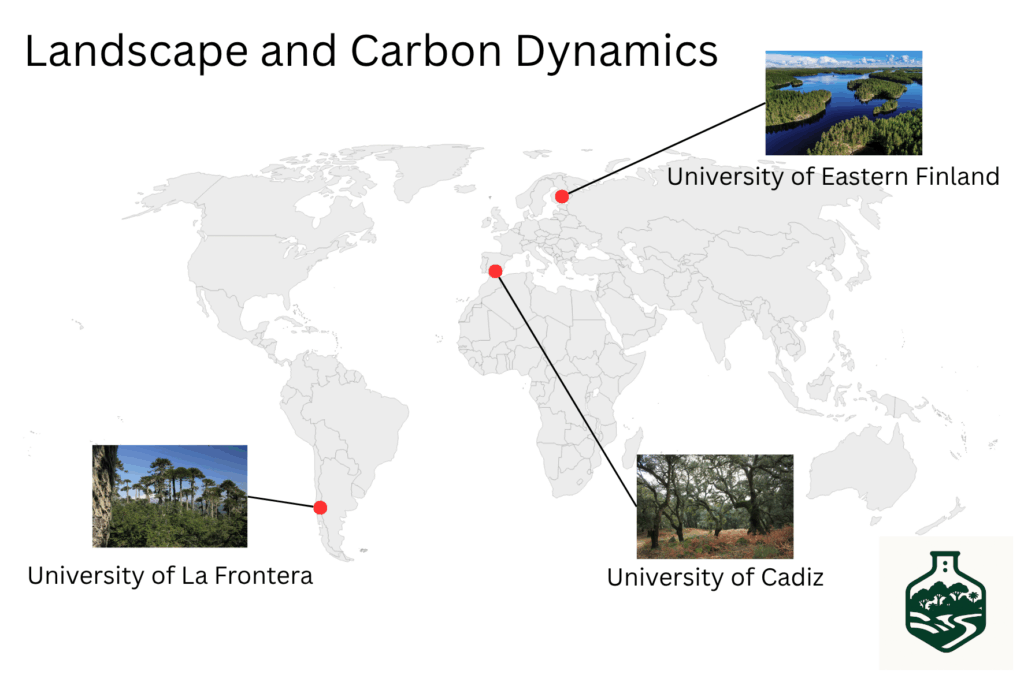
A coLab is a satellite research group embedded within a host institution in different countries, that is formally linked to Landscape and Carbon Dynamics, created to pursue shared research agendas and deliver joint projects, publications, supervision, and funding applications across common topics.
International coLabs
The co-Lab at the Universidad de La Frontera (Chile) focuses on carbon modelling across dynamic land-use mosaics and native forests, linking plot networks and high-resolution earth observation to track stocks, sequestration, and emissions. We develop and validate data-driven models, evaluate land-use change trajectories and quantify mitigation potential through restoration, silviculture, and avoided deforestation. The research delivers spatially explicit baselines, scenario analyses, and monitoring frameworks that support nature-based solutions, climate policy implementation, and resilient management of global native forests.
The coLab at the University of Eastern Finland (Finland) advances evidence-based forest management by integrating global databases, field experiments, forest inventory data, and multi-scale remote sensing with ecosystem-services modelling, focusing on planted areas, and traditional forest management. We quantify biomass production, carbon storage and fluxes, water regulation, and recreation, coupling growth and yield models with spatial optimisation and decision-support tools to evaluate silvicultural regimes under climate change.
The co-Lab at the University of Cádiz (Spain) studies Mediterranean-type terrestrial ecosystems across coastal–inland mosaics, integrating heathlands, shrublands, cork-oak woodlands and laurel forests within a coherent ecological monitoring and carbon–biodiversity assessment framework. The research delivers spatially explicit baselines, scenario analyses and long-term monitoring frameworks that enable nature-based solutions, inform climate and biodiversity policy implementation, and support resilient management of biodiversity-rich socio-ecological landscapes in Andalusia and comparable Mediterranean regions globally.
Publications
Hoyos‐Santillan, J., Chavarría, J., Castillo-Bethancourt, L. M., Vargas, J. E., Sanjur, A., Morales, J., Leung, B., Candanedo, I., Ibáñez, A., Manzane-Pinzon, E., González-Mahecha, E., & Mola-Yudego, B. (2025). Soil carbon stock densities in mangrove and forested wetland ecosystems of Panama. Scientific Data, 12, 1605. https://doi.org/10.1038/s41597-025-05877-x
Hoyos-Santillan, J., Miranda, A., Chavarría, J., Hormazabal, C., Mola-Yudego, B., & González-Mahecha, E. (2025). Plot and landscape-level estimates of tree biomass and carbon stocks in Panama’s mangrove Important Bird Areas. Scientific Data, 12(1), 1016. https://doi.org/10.1038/s41597-025-05354-5
Miranda, A., Catalán, G., Altamirano, A., Zamorano-Elgueta, C., Cavieres, M., Guerra, J., & Mola-Yudego, B. (2021). How much can we see from a UAV-mounted regular camera? remote sensing-based estimation of forest attributes in south american native forests. Remote Sensing, 13(11), 2151. https://doi.org/10.3390/rs13112151
Funding
Chile-FInland mobility programme (2026-2028)