Research aims
The Centre of Excellence in Peatlands, Climate Change and Ecological Restoration studies ongoing changes in northern peatlands. We aim to advance understanding of how climate change affects the biodiversity and climate responses of peat-rich ecosystems, and how upcoming large-scale restoration in Finland and elsewhere in Europe will affect northern peatlands.
The knowledge gained will be embedded into disaggregative decision-support tools, helping to make informed restoration decisions — particularly in situations where impacts on biodiversity and climate are in conflict.
Our ambition is to renew peatland science by uncovering mechanisms behind ecosystem resilience and tipping points, as well as vegetation and greenhouse gas dynamics and their interconnectedness.
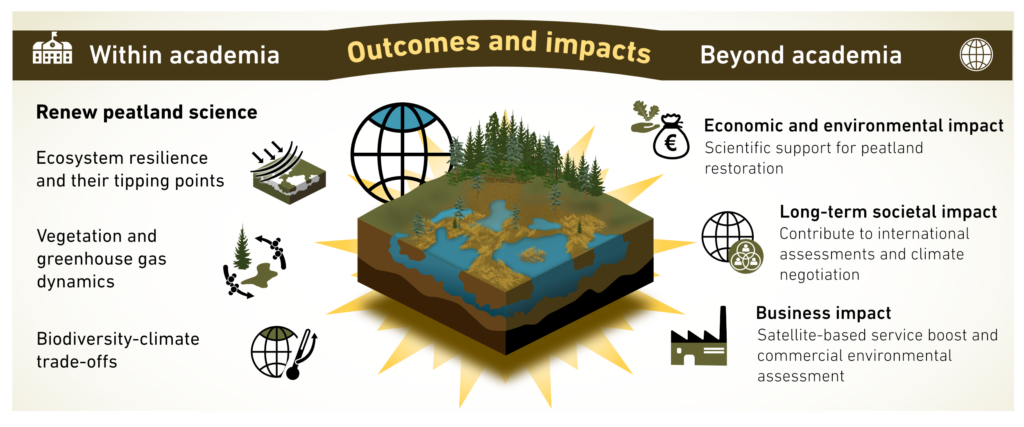
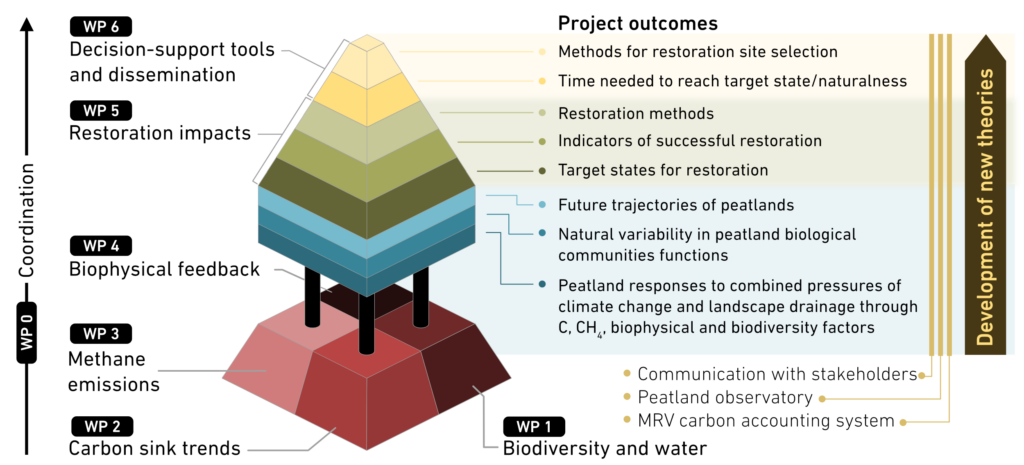
To reach our overall ambition, we combine paleoecology, remote sensing, experimental ecological research, modelling, and decision-support methods in a novel and original way. The core of our work consists of comprehensive mapping of the past, ongoing, and future pressures shaping northern peatlands’ biodiversity and water table (WP1), carbon sink function (WP2), methane emissions (WP3) and biophysical feedbacks (WP4).
These efforts will help us to define target states for restoration and assess the feasibility and consequences of restoration initiatives across northern Europe, Finland in particular (WP5).
Finally, we aim to develop new decision-support tools and make the latest peatland science accessible to citizens (WP6).
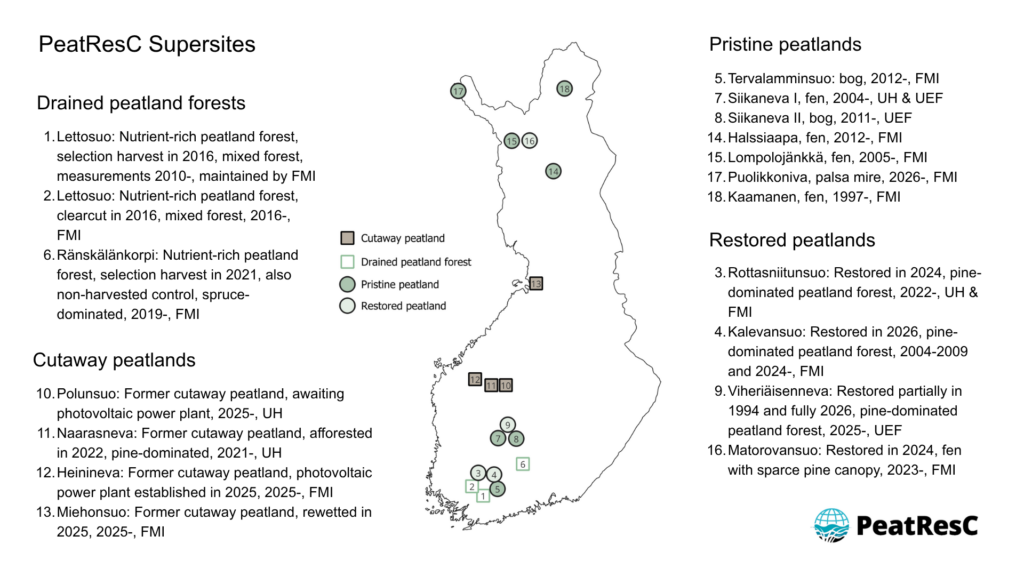
Our science is based on geographically and temporally extensive field observations. For example, we make use of peatland vegetation data from the Finnish National Forest Inventory and from the Finnish peatland restoration network. Furthermore, observed ecosystem-atmosphere greenhouse gas exchanges from our own field research platforms equipped with eddy covariance stations will be compared to international records through our broad network of collaborators and established flux data networks.
To reveal short-term responses and causal relationships, we make use of both new and existing experiments.