
Pattern making: Underestimated Mathematics in Action
Real-Life Math in Clothing Textiles and Fashion Design
Mathematics is quietly at work behind every well-fitting garment, yet it is often overlooked. From taking accurate body measurements to drafting blocks, adding ease, and grading sizes, every decision in pattern making relies on numerical precision. A small miscalculation can lead to wasted fabric, poor fit, or costly alterations making the consequences of weak mathematical understanding immediately visible.
Pattern making, therefore, is not merely a technical skill; it is applied mathematics in action.
Pattern making as mathematics in action
Every pattern is a mathematical narrative. Measurements are divided into halves, quarters, and other fractions. Ease is added deliberately, often 1–2 cm at the bust or waist to allow comfort and movement. Lines, angles, curves, symmetry, and proportion shape garments long before fabric is cut. Style features such as darts, sleeves, collars, and armholes depend on geometric reasoning rather than guesswork. When mathematical understanding is weak, creativity quickly turns into frustration as errors distort fit, balance, and overall design.
The Real Life Math project in practice
The Real Life Math project (Improving Mathematical Literacy in Real Life Contexts) aims to make mathematics visible, practical, and purposeful. Pattern making offers student teachers a concrete space to see mathematics at work. Here, calculations are not abstract they directly affect fit, efficiency, and quality in real design tasks. Through drafting, measuring, and adjusting patterns, students experience mathematics as a living tool rather than a classroom formula. This practical engagement strengthens both understanding and confidence.
Where financially literacy meets design
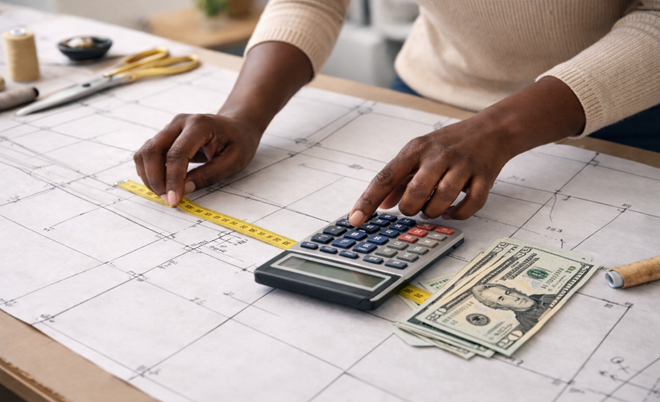
Pattern making is also about cost and sustainability. Designers must calculate fabric consumption, plan layouts, estimate labour, and determine pricing. Accurate measurements reduce waste and lower production costs.Financial literacy is embedded in every pattern:
- These skills enable designers to set realistic prices that balance expenses with profit.
- Knowing fabric requirements, labour inputs, and grading processes helps designers plan costs effectively.
- Understanding seam allowances, pattern pieces, and size ranges allows for accurate cost estimation.
In this way, mathematics supports not only design accuracy but also economic viability.
Why this matters for student teachers
Recognising mathematics and financial literacy as foundational to pattern making helps student teachers draft patterns that are accurate, reproducible, and economically informed. Mathematics shifts from being an abstract classroom subject to a practical tool for sustainable production.
This understanding strengthens both technical competence and professional confidence essential qualities for future educators and designers.
In pattern making, mathematics does not limit creativity; it anchors it. When paired with financial literacy, design moves beyond artistic expression to become a viable, sustainable practice.
This is real-life mathematics in action.
Writer
Dr. Florence Sebele
Senior lecturer
National University of Science and Technology
Department of Applied Art, Design and Technology
Zimbabwe