
Everyday Mathematics in the Food Lab for Home Economics Student Teachers – Cheese‑making Task
This project is part of the Real Life Math project. The aim of my project is to increase the visibility of everyday mathematics as part of home economics teacher education, to develop existing mathematical tasks, and to inspire student teachers to integrate mathematics into their teaching – potentially in collaboration with mathematics teachers. In this blog post, I will introduce the everyday mathematics that emerges in the preparation of home-made cheese.
Cheese making requires numeracy and basic arithmetic skills to measure ingredients and temperatures correctly, interpret pH values accurately, and perform basic calculations. A practical example of measurement skills is halving an egg. Half an egg is obtained by cracking an egg into a glass and whisking it until the texture is uniform. From this mixture of white and yolk, half is used.
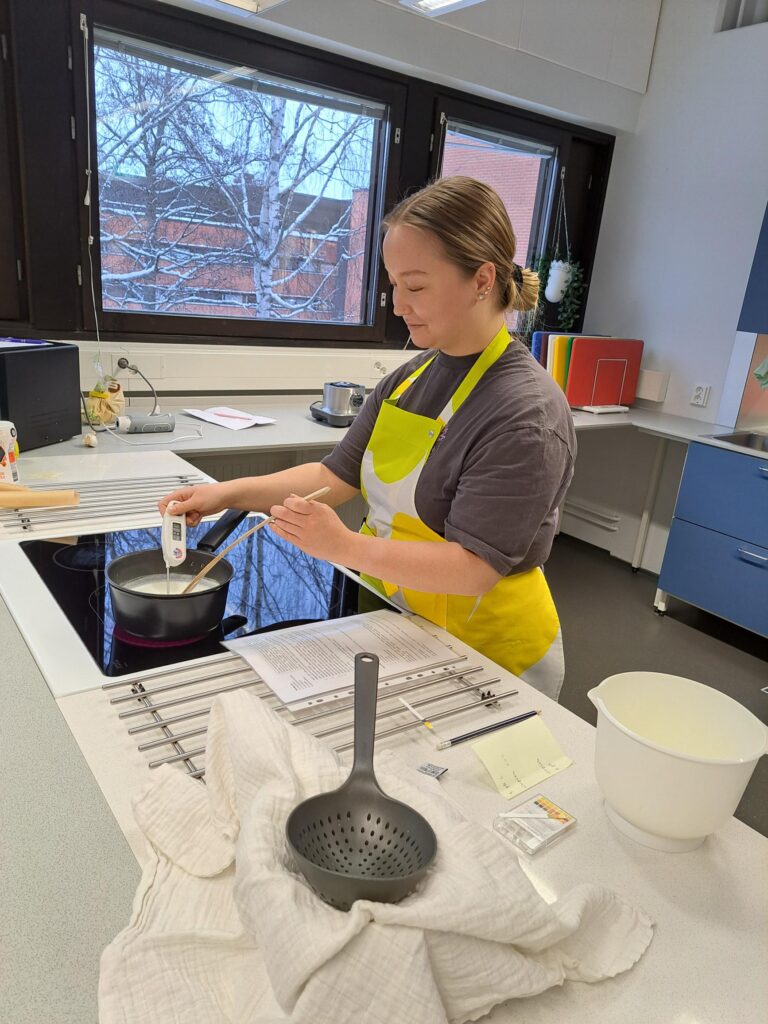
Cheese making involves measuring the milk temperature several times in the cheese vat. It is important to know how to measure the temperature correctly so that the thermometer is not placed on the bottom of the vat but in the middle. In addition, the milk must be stirred during heating to even out temperature differences and to prevent the milk from forming a skin or boiling over.
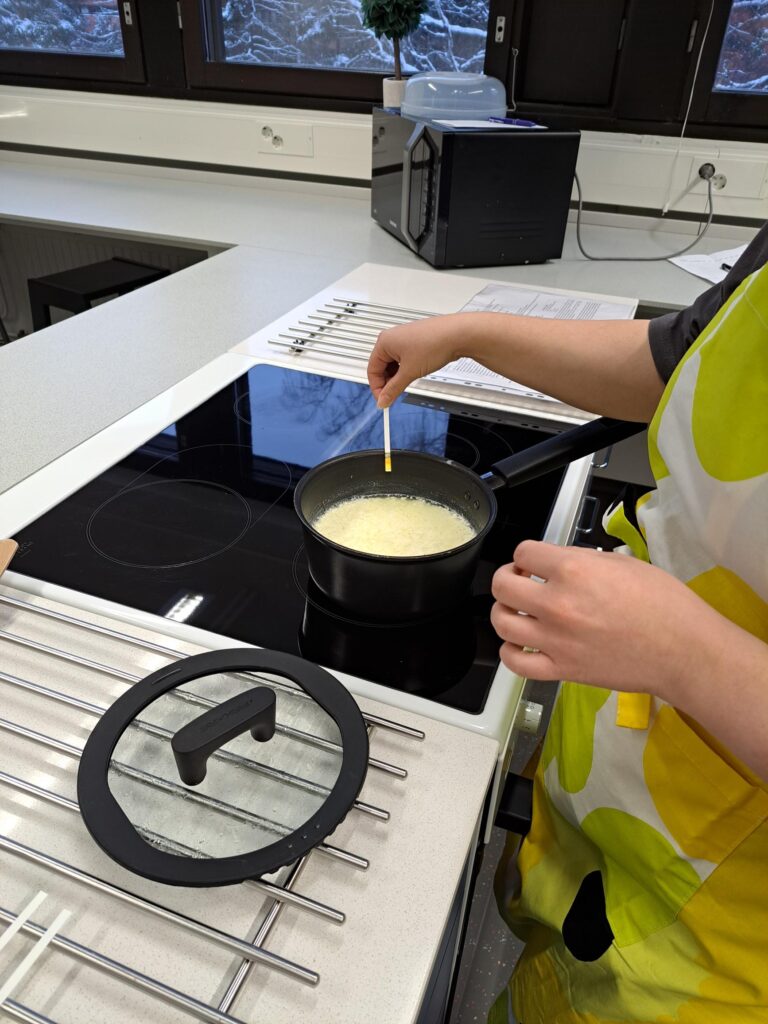
The pH value of the milk is measured cold before heating and before adding the rennet mixture (buttermilk + egg). Temperature also affects the pH value. The pH is measured a second time after adding the rennet and after the curd has separated, once the curd has cooled slightly.
As a calculation and problem solving task, the students were asked to determine how to calculate the total fat content of the homemade cheese. This required the teacher’s assistance. The cheese was made using 5 dl of whole milk and 2 ½ dl of fat‑free buttermilk. Whole milk contains 3.5 g of fat per 100 grams. The fat content of the prepared cheese is obtained by multiplying 3.5 g by five, resulting in 17.5 g.
Attached is the recipe for the homemade cheese we prepared in class with step‑by‑step photos. I recommend trying cheese making yourself!
Buttermilk Cheese
Ingredients
- ½ l whole milk
- 2 ½ dl fat‑free buttermilk (If the buttermilk is very fresh, let it stand at room temperature for 10–12 hours before making the cheese.)
- ½ egg
- ¼ tsp salt
- fresh basil
Instructions
- Pour the milk into a thick‑bottomed (stainless steel or non‑stick, e.g. Teflon) saucepan.
Measure the pH of the milk. Heat it to just below boiling (85–90°C), stirring continuously with a wooden spatula along the bottom of the pot to prevent scorching.
- Lightly beat the egg in a bowl and mix in the buttermilk.
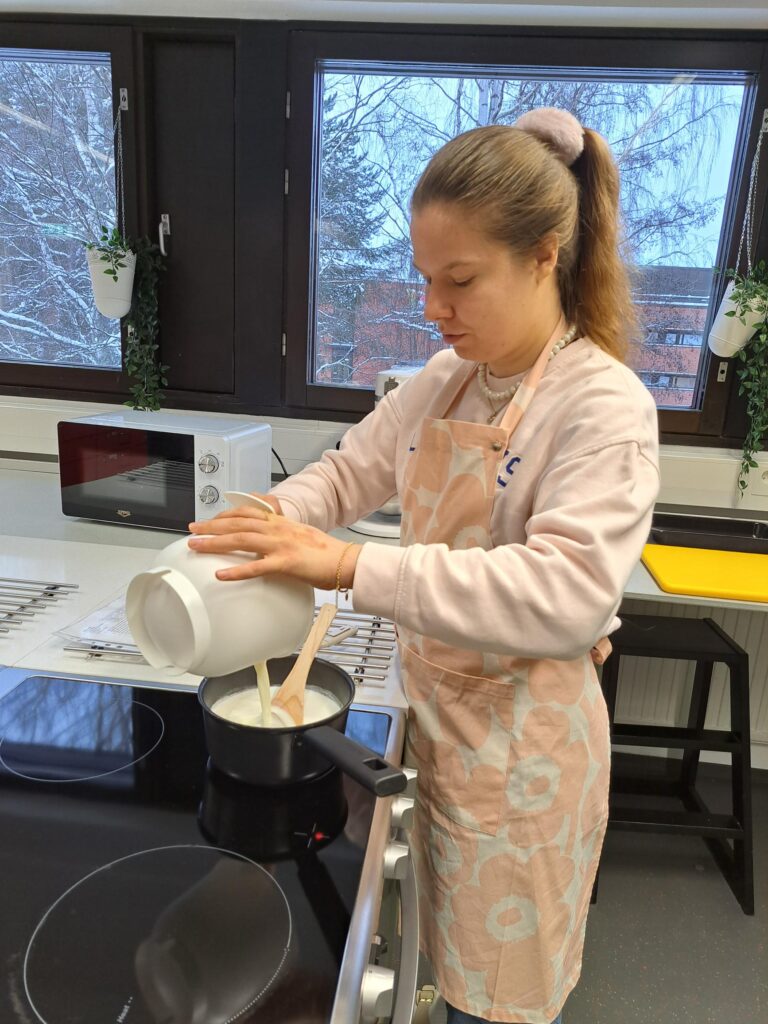
If the buttermilk is very fresh, let it stand at room temperature for 10–12 hours before making the cheese. - Slowly stir the buttermilk mixture into the hot milk.
Heat again to near boiling (about 90°C). Stir gently along the bottom of the pot during heating.
- Remove the pot from the heat and cover with a lid.
Allow the whey to separate from the curd for about 30 minutes. Measure the pH.
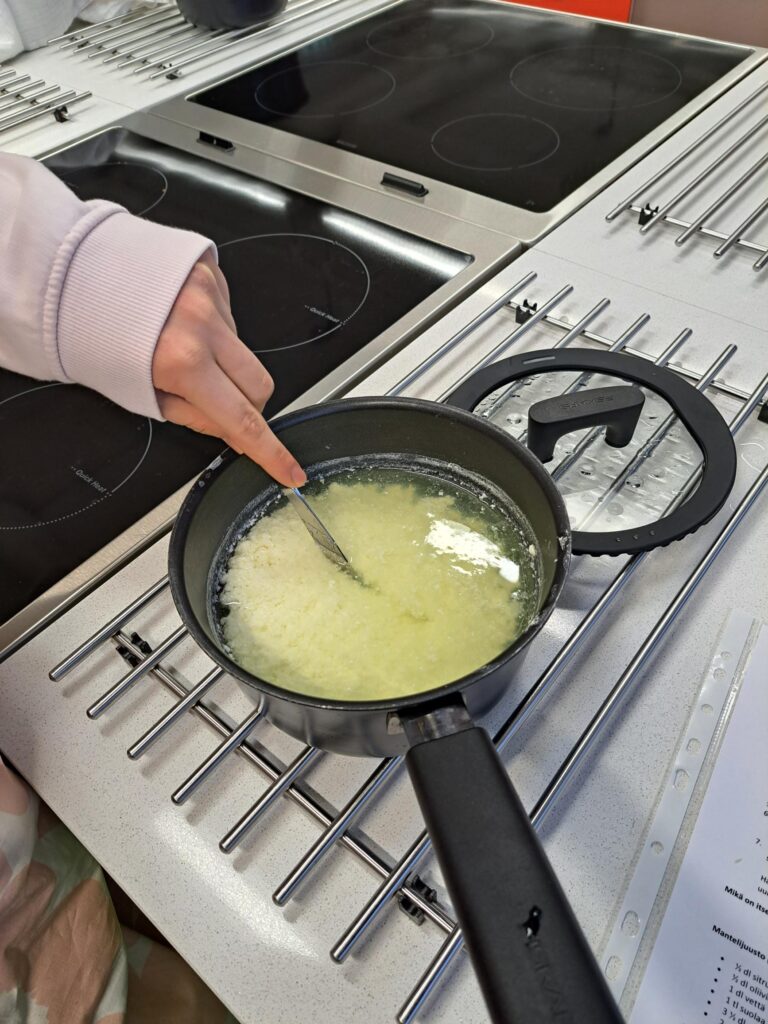
- Cut a criss‑cross pattern into the curd with a knife.
Let the whey separate for another 5 minutes.
- Lift the curd with a slotted spoon into a sieve lined with cheesecloth.
Press the whey out gently. Mix the salt evenly into the curd. Place a light weight on top of the cheese.
Allow the cheese to firm up in the refrigerator (overnight).
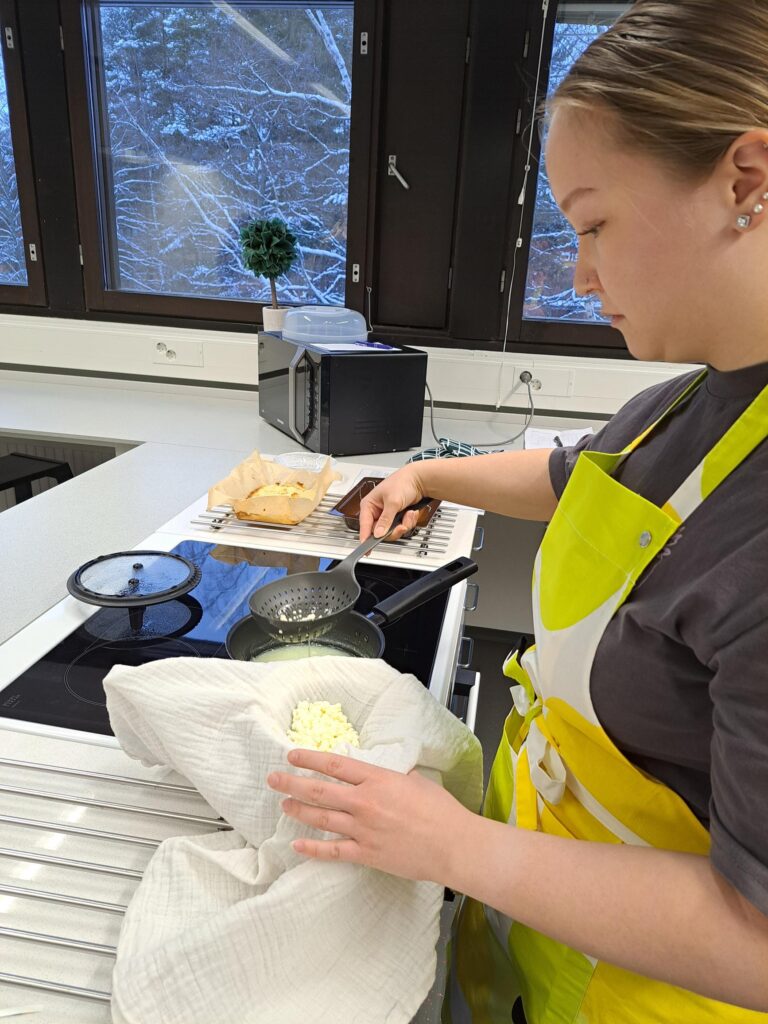
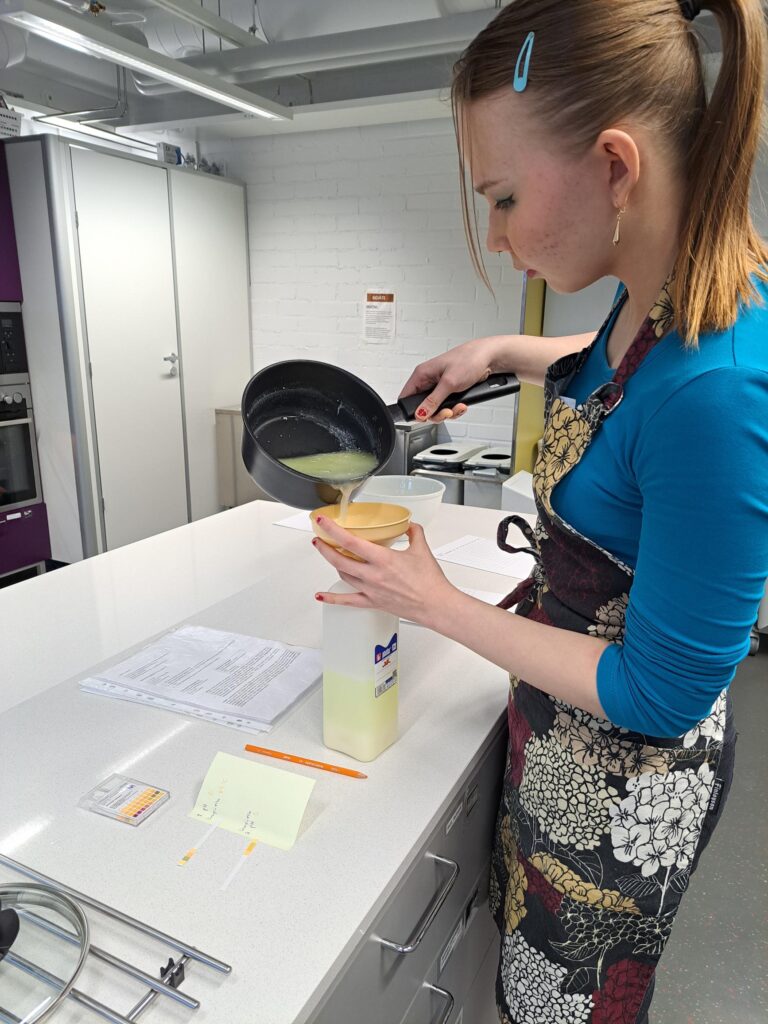
Cool the whey and freeze it for later use.
- Invert the firm cheese onto a plate.
Season and garnish with fresh basil. Cut the cheese into pieces for a salad.
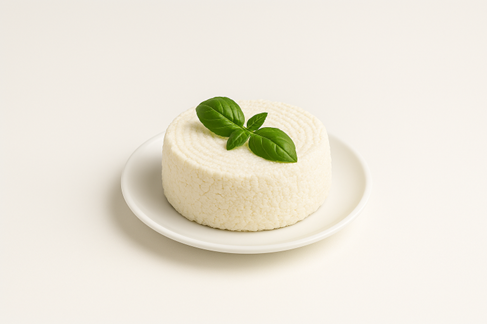
AI-generated image. Ps. I forgot to take pictures of the finished cheeses. 😉
This is real-life mathematics in action.
Writer
Dr. Johanna Hokkanen
University lecturer of home economics
University of Eastern Finland
School of Applied Educational Science and Teacher Education
Joensuu