
Transition Network Analysis Workshop
The Third TNA Workshop: A Hands-On Tutorial on Capturing Dynamics in Learning and Interaction Processes with Transition Network Analysis
co-located with LAK 2027, Recife, Brazil
This workshop represents the third edition in the TNA workshop series, which will take place as a pre-conference event to the LAK 2027 conference, with the inaugural workshop taking place at the LAK’26 conference in Bergen, Norway, and the following workshop at the Festival of Learning 2026 in Seoul, Korea. Our event will be a full-day, interactive workshop/tutorial that combines lectures, discussions, demonstrations, paper presentations, tutorials, and hands-on activities. The first half of the workshop will focus on introducing the topic, presenting illustrative examples, and featuring presentations of accepted research papers by the participants. The second half will be dedicated to hands-on activities, allowing participants to apply the concepts and techniques introduced earlier in the day through practical exercises.

Eduardo Oliveira

Di Wu

Kamila Misiejuk

Sonsoles López-Pernas

Mohammed Saqr
What is TNA?
Transition Network Analysis (TNA) is a framework for modeling learning as a dynamic and relational process, first introduced at the LAK Conference in 2025. TNA combines the sequential perspective of transitions between learning events, with a relational representation of how these events are connected. In addition, TNA is situated within Dynalytics, an overarching framework and methodological ecosystem designed for the analysis and rigorous validation of dynamics of interactive and complex dynamical systems.
TNA combines sequential transition with relational dynamics. In doing so, it enables researchers to investigate what learners do and in what order, as well as how different learning events are structurally related. As a method, TNA can be used to mine cliques, communities, and the chains of transitions that characterize the structure of the modeled learning process. TNA also has tools to reveal the central events of a process through centrality and edge-centrality measures and includes confirmatory testing that verifies that each edge in the model, or the differences between models, is not a product of random artefact but rather represents meaningful patterns in student interactions. Furthermore, TNA as a toolkit includes several modeling approaches suited to different learning contexts ranging from Markov-based models for sequential analysis, Frequency-based TNA, Attention TNAs, Co-occurrence Network Analysis, and Heterogeneous TNA. Also, recent advances in TNA aim at capturing higher-order transitions beyond Markov models with higher-order transition networks.
TNA and its variants have been applied across a wide range of learning contexts. Several studies have examined student engagement with generative AI, while others have modeled learning processes during lab sessions using learning management system data, and tracked the development of performance, engagement, and problem-solving efficiency across blended learning phases. More recently, TNA has been extended beyond interaction analysis itself, with research exploring whether a large language model could serve as an interpretation layer that translates temporal representations such as TNA models into natural language explanations for educators. TNA was also used in modeling non-AI-related contexts. For example, to model complex problem-solving processes from the PISA 2012 computer-based assessment, to characterize teacher profiles in the co-design of AI-supported scientific inquiry activities, or to model the transitions of students’ daily motivational profiles evolved over time.
While TNA can be applied across a wide range of data types and research questions, this workshop focuses on human–AI interaction, given the timeliness and growing relevance of the topic. The skills taught, however, are transferable to other applications involving similar types of data. The dialogical nature of interactions, the processes of learning with AI, the dynamics through which exchanges unfold, as well as their underlying structures and relationships, are all relevant across a wide range of research contexts. The workshop is intended for educators, professional staff, and researchers who are keen to better understand human-AI interaction, including participants without technical or computational backgrounds.
Key skills in the tutorial include
- Understanding the structure of the data
- Build TNA models
- Network visualization
- Other visualizations: frequencies, mosaic plots, histograms
- Statistical validation: bootstrapping and permutation tests
- Centrality measures: betweenness, diffusion, closeness, degree
- Clique and structural pattern detection
- Community detection
- Sequence analysis and visualization
- Compare learning processes and group analysis
- Group-specific network metrics
Schedule
Our event will be a full-day interactive workshop/tutorial combining lectures, discussions, demos, paper presentations, tutorials, and hands-on practice.
Detailed schedule TBA
Important dates
- Submission Deadline: 4 Dec 2026
- Notification of Acceptance: 18 Dec 2026
- Deadline for camera-ready: 4 Jan 2027
- Workshop celebration at LAK 2027: 8-9 Mar 2027
Call for papers
The presented papers will be published in a volume in Springer Communications in Computer and Information Science (CCIS). We accept full papers (12–15 pages) and short
papers (6-11 pages). Guidelines are available in this link: https://link.springer.com/series/558/information-for-authors-and-editors
We accept empirical, methodological, theoretical, or software/data contributions for this section of the workshop related to the following topics:
- Empirical studies using TNA to analyze learning processes, collaboration, learning activities or event data
- Position papers that address areas of relevance to the temporal dynamics of learning, e.g., discussion, opinion, or theoretical papers that are related to learning transitions, or changes across time.
- Novel methodological developments or extensions of TNA (e.g., Frequency-based TNA, Attention Network Analysis, Co-occurrence TNA).
- Comparative or combined analyses between TNA and other temporal or network-based methods
- Learning theories informed or related to TNA.
- Tool development, visualization techniques, or open datasets for TNA
- Applications of TNA to model human–AI interactions.
🔗 Submission link: https://easychair.org/conferences?conf=tna27
Get started with TNA!
To help you prepare your contribution, we have put together a series of resources
Our tools
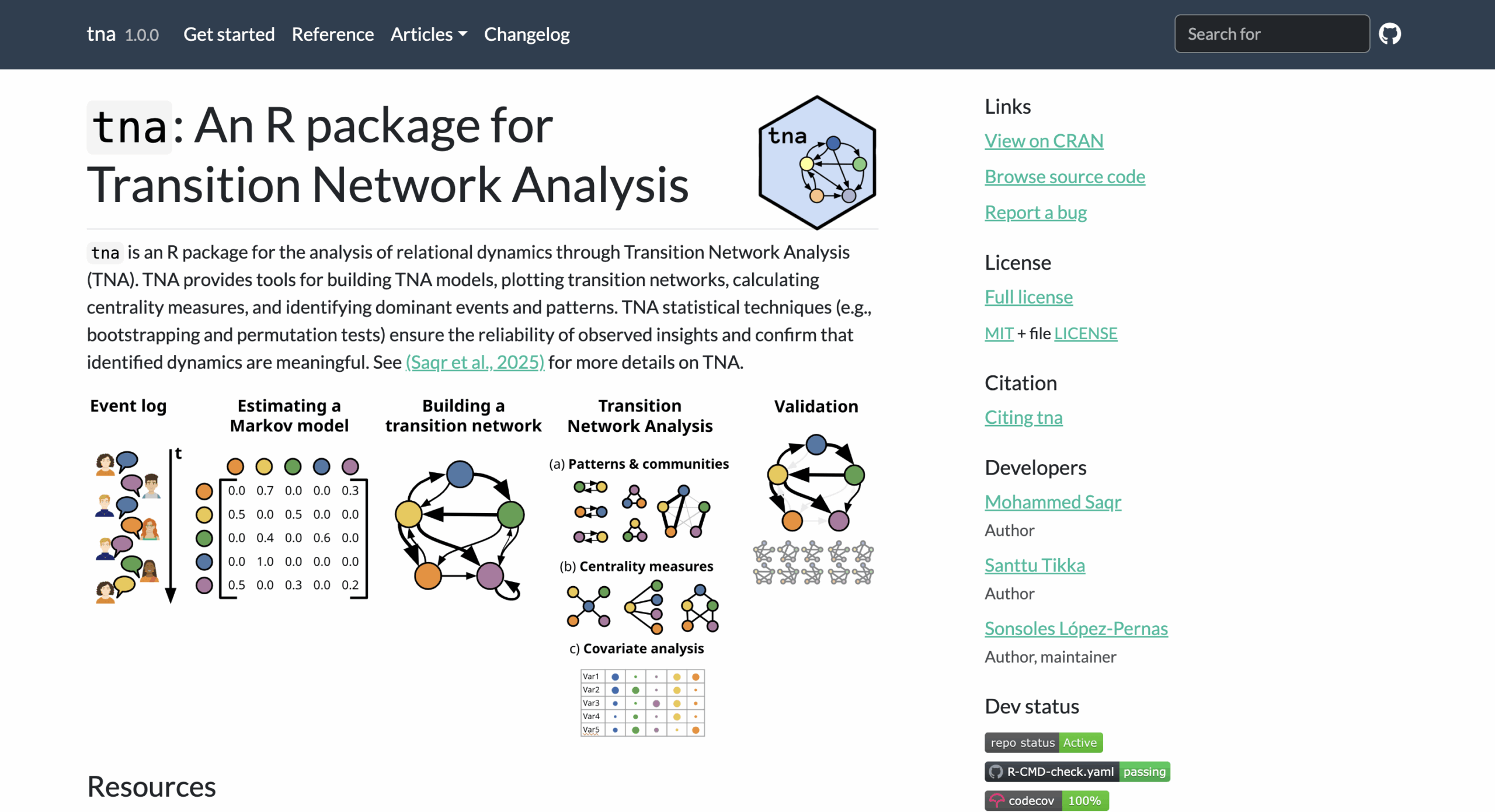
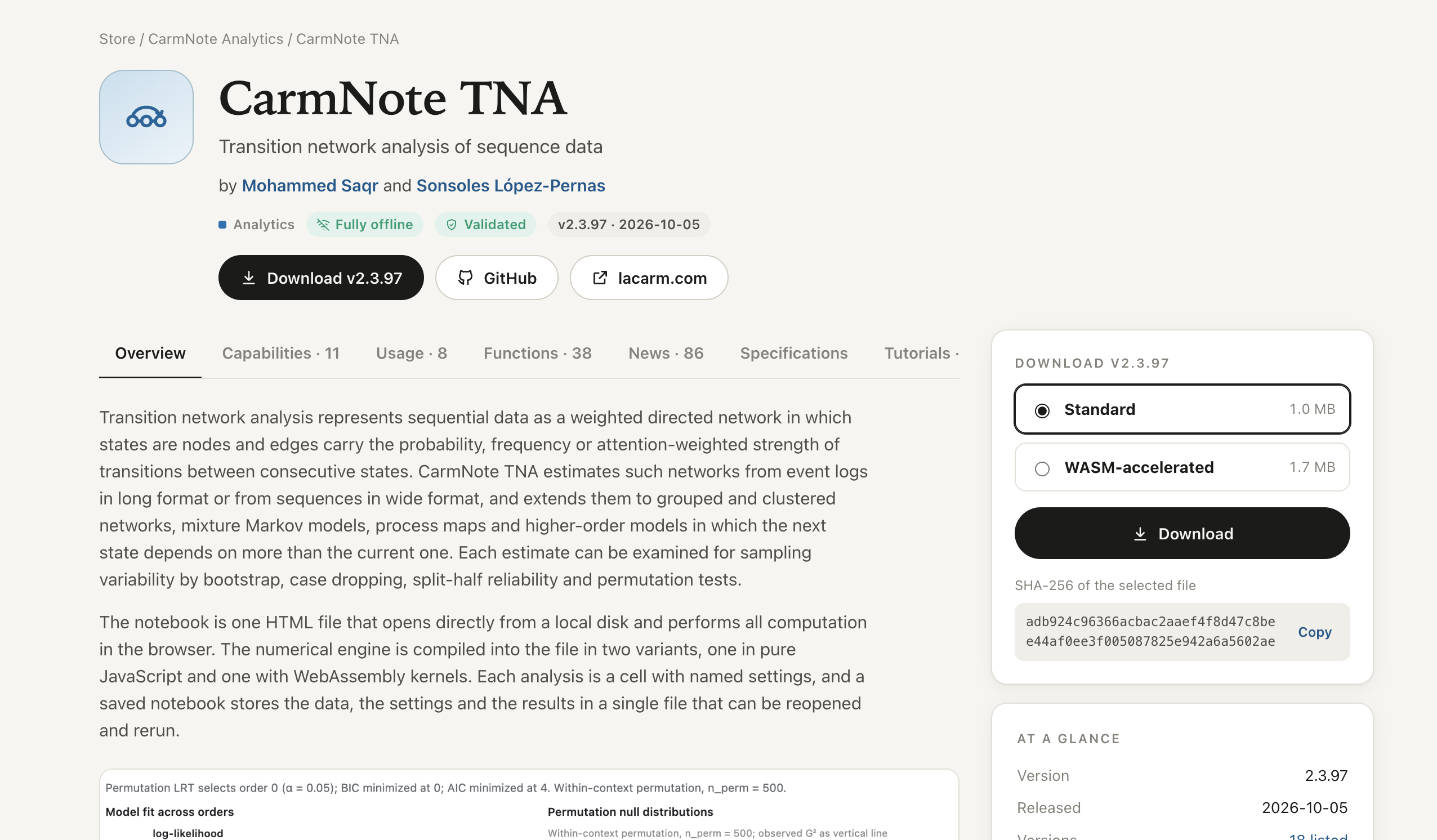
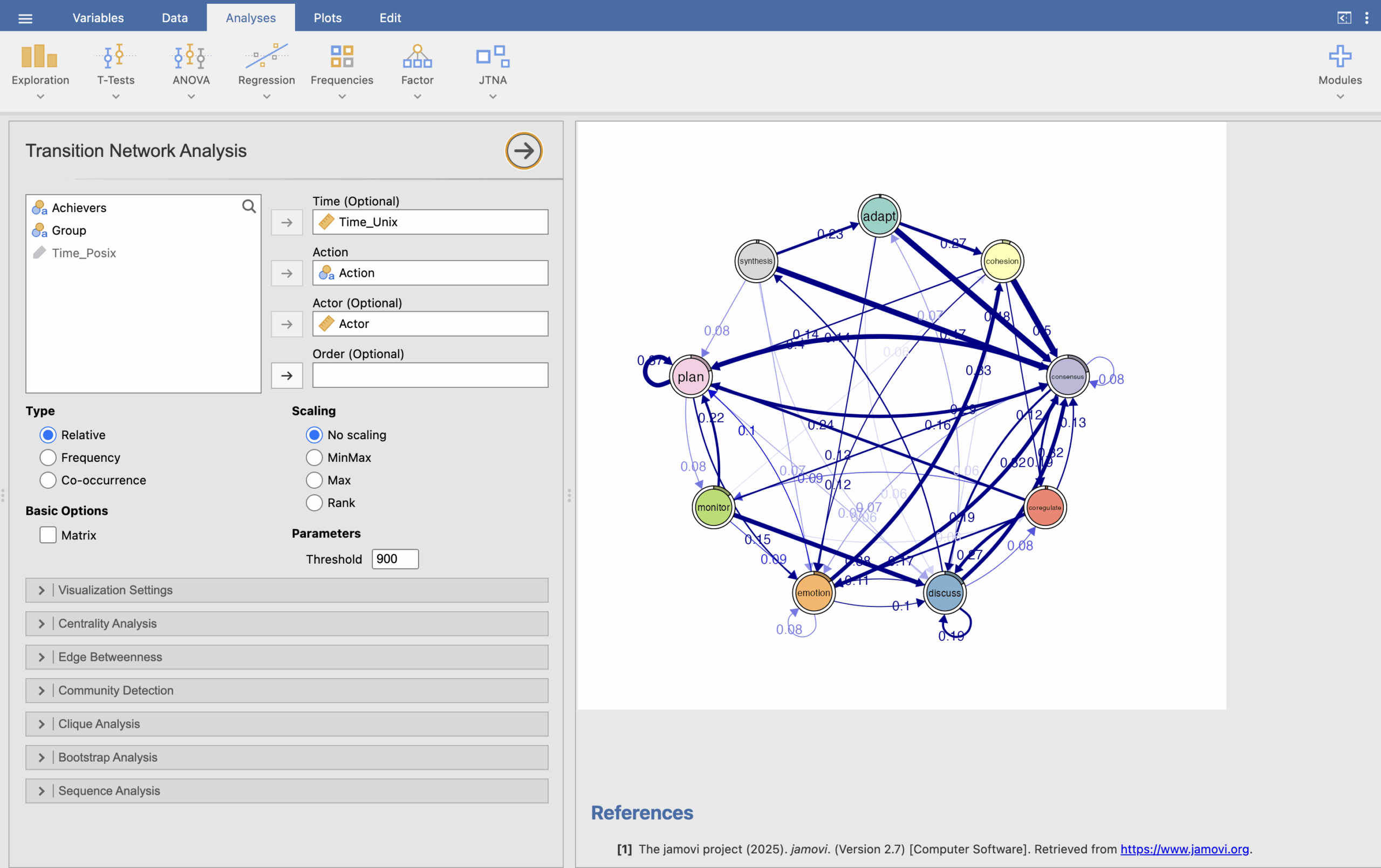
Tutorials
 There are four tutorials available about TNA:
- Basic tutorial: Mohammed Saqr, Sonsoles López-Pernas, Santtu Tikka (2025). Mapping Relational Dynamics with Transition Network Analysis: A Primer and Tutorial. In M. Saqr & S. López-Pernas (Eds.), Advanced Learning Analytics Methods: AI, Precision and Complexity (in – press). Springer. https://lamethods.org/book2/chapters/ch15-tna/ch15-tna.html
- Frequency-based TNA: Mohammed Saqr, Sonsoles López-Pernas, Santtu Tikka (2025). Capturing The Breadth and Dynamics of the Temporal Processes with Frequency Transition Network Analysis: A Primer and Tutorial. In M. Saqr & S. López-Pernas (Eds.), Advanced Learning Analytics Methods: AI, Precision and Complexity (in – press). Springer. https://lamethods.org/book2/chapters/ch16-ftna/ch16-ftna.html
- Clustering: Sonsoles López-Pernas, Santtu Tikka, Mohammed Saqr (2025). Mining Patterns and Clusters with Transition Network Analysis: A Heterogeneity Approach. In M. Saqr & S. López-Pernas (Eds.), Advanced Learning Analytics Methods: AI, Precision and Complexity (in – press). Springer. https://lamethods.org/book2/chapters/ch17-tna-clusters/ch17-tna-clusters.html
- TNA for Human-AI interaction: López-Pernas S., Misiejuk K., Oliveira E., Saqr M. (2026). A methodological toolkit for studying human-AI interaction. In Research Perspectives on Human-Centered AI. Edward Elgar. S. Grassini (Eds.) https://go.uef.fi/method-toolkit-hai