Learning Analytics and Artificial Intelligence in Education Summer Course (2026)
The Learning Analytics and Artificial Intelligence in Education summer course introduces the foundational principles, theoretical background, and practical applications of both fields. The course uses authentic scenarios and real-life datasets to demonstrate how learning analytics and AI can be applied in educational contexts. In the AI component, participants design custom pedagogical chatbots and teaching agents. They also learn to automate tasks such as qualitative coding of discourse data, processing large document collections, and batch evaluation of datasets. Also, students will learn to create learning and assessment resources, analyze educational data, automate feedback, and understand the principles of explainable artificial intelligence.
In the learning analytics component, students will explore analytical approaches, including network analysis to examine learning processes, sequence analysis to trace how learning unfolds, process mining to understand learning workflows, and clustering to identify patterns in educational data. Additional common analytical and statistical techniques are also introduced and all of this is done with easy yet powerful tools. Students practice these methods using datasets from learning management systems, collaborative platforms, and other authentic sources. Participants are also welcome to work with their own data. In addition to developing analytical skills, students learn how to interpret results and derive meaningful insights in a supportive learning environment.
The primary goal of the course is to build practical knowledge and skills through hands-on work with real-world data, tools, and methods. The competencies developed in the course are transferable to other fields that apply analytics and artificial intelligence.
No prior background knowledge is required. The course has been offered for 11 editions and has attracted participants from diverse disciplines worldwide. It progresses from basic concepts to more advanced applications using accessible tools suitable for a wide range of skill levels.
Why Our Course is Unique
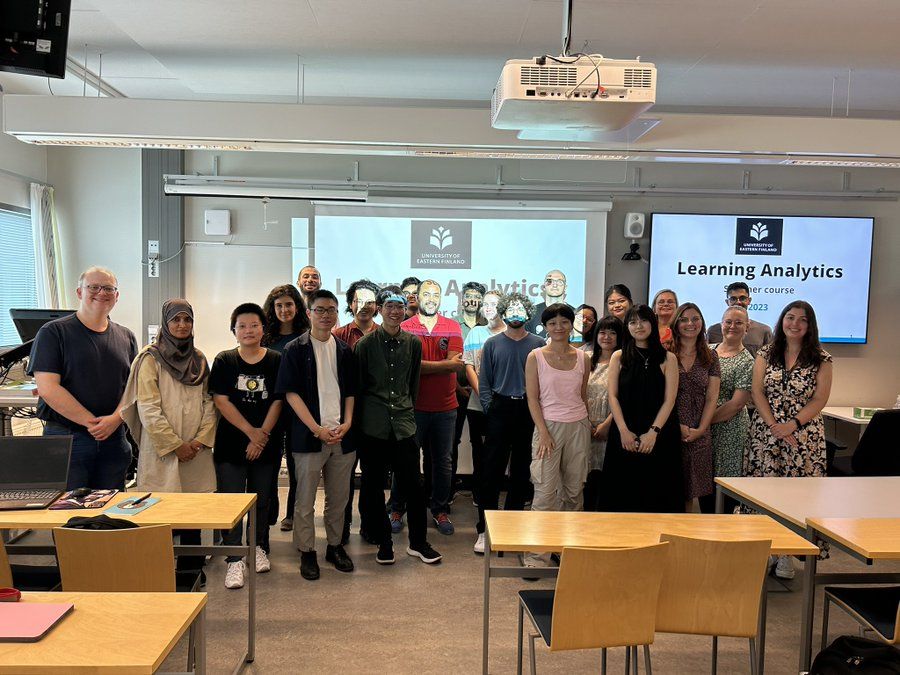
The instructors have vast experience in the field with over 250 publications, two LA and AI methodological books, and have experience in running 11 editions of the LA course with students from over 40 countries and all the six continents of the world. You can look at their profiles here: Mohammed Saqr and Sonsoles López Pernas, or the LA unit at UEF. More importantly, we have developed several of the methods we are teaching and created custom software and tools that makes sophisticated methods accessible and easy to use with no technical expertise. Gaining knowledge and skills and methodological know-how of the latest advances in AI and LA is made easy and worthwhile. You can view these apps here and here . The tentative schedule is below.
First Week
The first week begins with an introduction to the course, the participants, and the taxonomy and mechanisms of learning analytics. This is followed by an overview of data types and core learning analytics methods, along with a session on using Artificial Intelligence to generate data and a discussion to guide participants’ personal projects. The course then introduces Social Network Analysis, covering fundamental concepts and examples from the literature. This is followed by extensive hands-on practice, where students conduct Social Network Analysis and Co-occurrence Network Analysis and use Artificial Intelligence to support network interpretation. Next, the course explores process mining and transition network analysis, illustrated with examples from the literature. Students practice transition network analysis through hands-on demonstrations and advanced practical exercises. The focus then shifts to sequence mining, beginning with an introduction and literature examples, along with an interactive Artificial Intelligence session. Students gain advanced practical experience with sequence mining. The week concludes with predictive learning analytics and clustering, including practical exercises, a discussion on Artificial Intelligence, bias, and prescriptive analytics, and collaborative group work.
Second Week
The second week begins with an introduction to Artificial Intelligence, Artificial Intelligence in Education, and Large Language Models. Students then move to hands-on practice designing Artificial Intelligence chatbots, followed by collaborative group work. The following sessions explore Artificial Intelligence applications for automating educational tasks. Participants develop practical skills by creating custom Artificial Intelligence agents and tools through guided exercises, accompanied by additional group work. The course then focuses on Artificial Intelligence applications in educational research, emphasizing practical activities such as using Artificial Intelligence for data annotation and generating synthetic data. The final sessions address the privacy and ethics of Learning Analytics and Artificial Intelligence in Education, including discussions on bias, prescriptive analytics, and examples from the literature. The course concludes with final group work, project presentations, and a comprehensive wrap-up of the course.
For contact information
All inquiries and questions about the course can be directed to [email protected], and for registration, payment, and all other issues, please contact [email protected]