
Workshop: “Modeling Dynamics of Learning and Learners with the Transition Network Analysis Toolkit”
at Festival of Learning (Seoul, South Korea)
27-28 June 2026
This workshop introduces participants to Transition Network Analysis (TNA), a comprehensive framework for modeling learning processes through rigorous statistical methods. Participants will explore how TNA enables rigorous analysis of learning dynamics—with or without coding expertise. TNA includes a rich repertoire of tools and techniques for examining interaction data, including methods for visualizing and identifying recurring structural patterns such as dyads, triads, communities, and clusters. A key focus is TNA’s integration of statistical validation techniques including bootstrapping, permutation testing, and case-dropping, allowing researchers to validate individual network edges with p-values and effect sizes, compare patterns across learner subgroups, and explain observed dynamics with edge-level significance. The workshop covers TNA’s theoretical foundations and key variants: Frequency-based TNA, Attention Network Analysis, Heterogeneous TNA, and Co-occurrence Network Analysis. Through guided instruction and hands-on practice, attendees will learn to identify suitable data and research questions, perform data preprocessing, and apply TNA using both the tna R package and no-code platforms (tna-web and JTNA).




What is TNA?
TNA is a novel framework for modeling the learning process through a rich toolkit of rigorous, statistically validated methods. It provides an accessible yet powerful environment for researchers to perform sophisticated analyses—without requiring coding expertise. TNA supports the computation of metrics at the graph, node, and edge levels, and facilitates the identification of recurring structures such as dyads, triads, communities, and clusters. TNA integrates statistical validation techniques —including bootstrapping, permutation testing, and case-dropping— to assess the robustness and replicability of findings. This allows researchers to statistically validate each edge in the network with both p-values and effect sizes —an unprecedented capability in process modeling. Furthermore, TNA enables comparison across subgroups and the explanation of observed patterns with edge-level statistical significance. By combining network analysis with statistical rigor, TNA supports theory development and hypothesis testing grounded in empirical evidence.
The workshop’s learning objectives include helping participants develop a solid understanding of theoretical foundations and methodological affordances of TNA and its key variants: Frequency-based TNA, Attention Network Analysis, and Co-occurrence TNA. Attendees will learn how to choose appropriate data and research questions for TNA, perform necessary data preprocessing, and apply the method using both point-and-click platforms where no code or programming experience is required (tna-web and JTNA) as well as code-based tools (tna R package).
Schedule
9:00 – 9:15 Welcome & Workshop overview
9:15 – 10:00 Introduction to theoretical foundation and use cases in TNA
10:00 – 10:15 Coffee break
10:15 – 10:45 Capturing human-AI dynamics with TNA
10:45 – 12:00 Paper presentations with plenum discussions
12:00 – 13:00 Lunch break
13:00 – 14:00 Interactive demo of TNA Jamovi and TNA R package
14:00 – 14:45 Hands-on TNA and participatory exercises in small groups (I)
14:45 – 15:00 Coffee break
15:00 – 16:00 Hands-on TNA and participatory exercises in small groups (II)
16:00 – 17:00 Closing, reflections, discussions
Call for papers
The presented papers will be published in a volume in Springer Communications in Computer and Information Science (CCIS). We accept empirical, methodological, theoretical, or software/data contributions for this section of the workshop related to the following topics:
- Empirical studies using TNA to analyze learning processes, collaboration, learning activities or event data
- Position papers that address areas of relevance to the temporal dynamics of learning, e.g., discussion, opinion, or theoretical papers that are related to learning transitions, or changes across time.
- Novel methodological developments or extensions of TNA (e.g., Frequency-based TNA, Attention Network Analysis, Co-occurrence Network Analysis).
- Comparative or combined analyses between TNA and other temporal or network-based methods
- Learning theories informed or related to TNA.
- Tool development, visualization techniques, or open datasets for TNA
Important dates
- Early submission Deadline: 1 May 2026
- Notification of Acceptance (early): 14 May 2026
- Late submission Deadline: 1 June 2026
- Notification of Acceptance (early): 14 June 2026
- Deadline for camera-ready: 20 June 2026
- Workshop celebration at Festival of Learning 2026: 27-28 June 2026
Submission guidelines
Submissions should be anonymized and be submitted through EasyChair. Each paper will be double-blind peer-reviewed. Accepted papers will be presented during the workshop and published in Springer CCIS. We accept regular papers (8-12 pages), short papers (5-8 pages), and work in progress (5-9 pages).
🔗 Submission link: https://easychair.org/conferences/?conf=tnafol26
Get started with TNA!
To help you prepare your contribution, we have put together a series of resources
Our tools
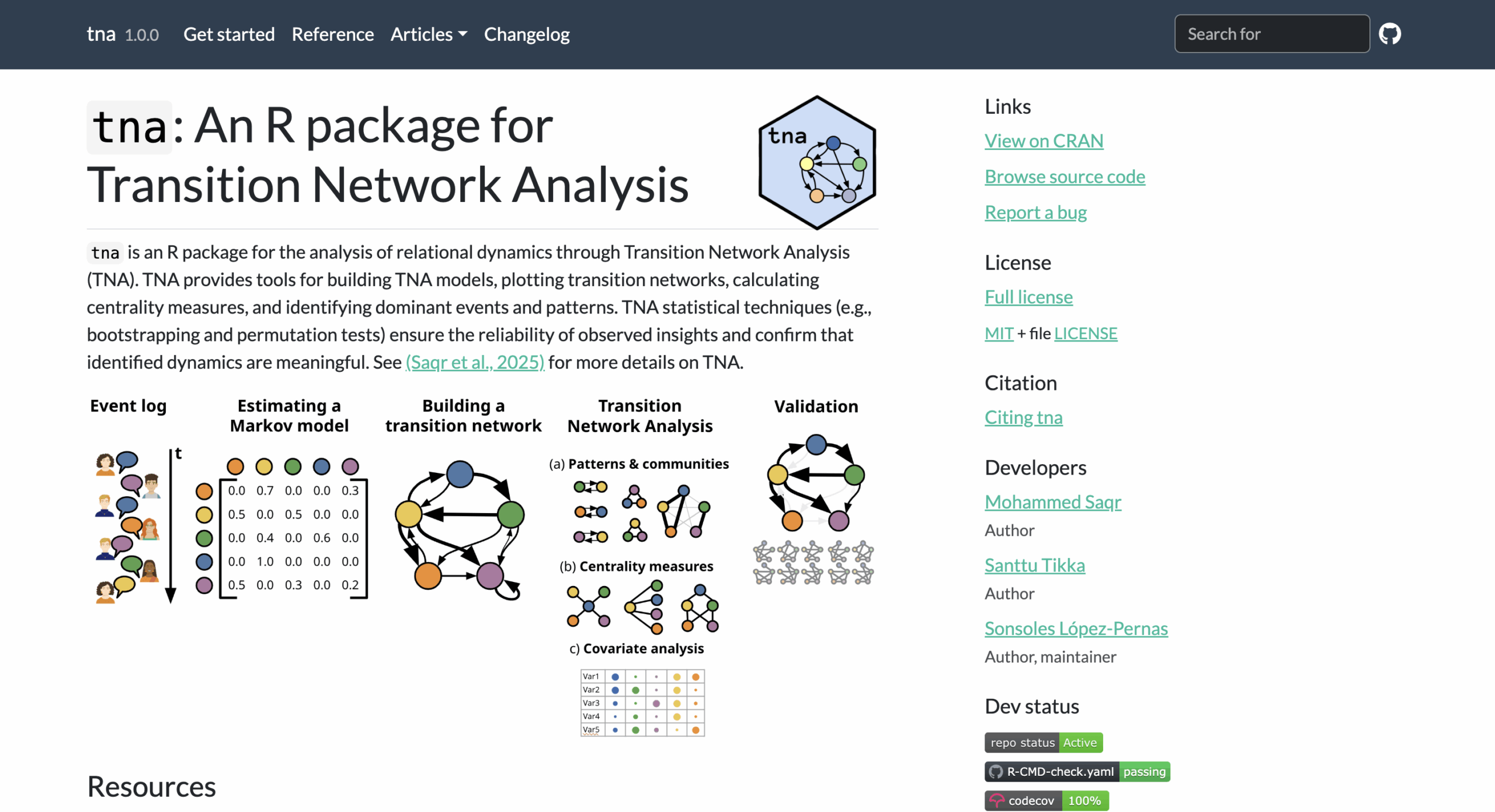
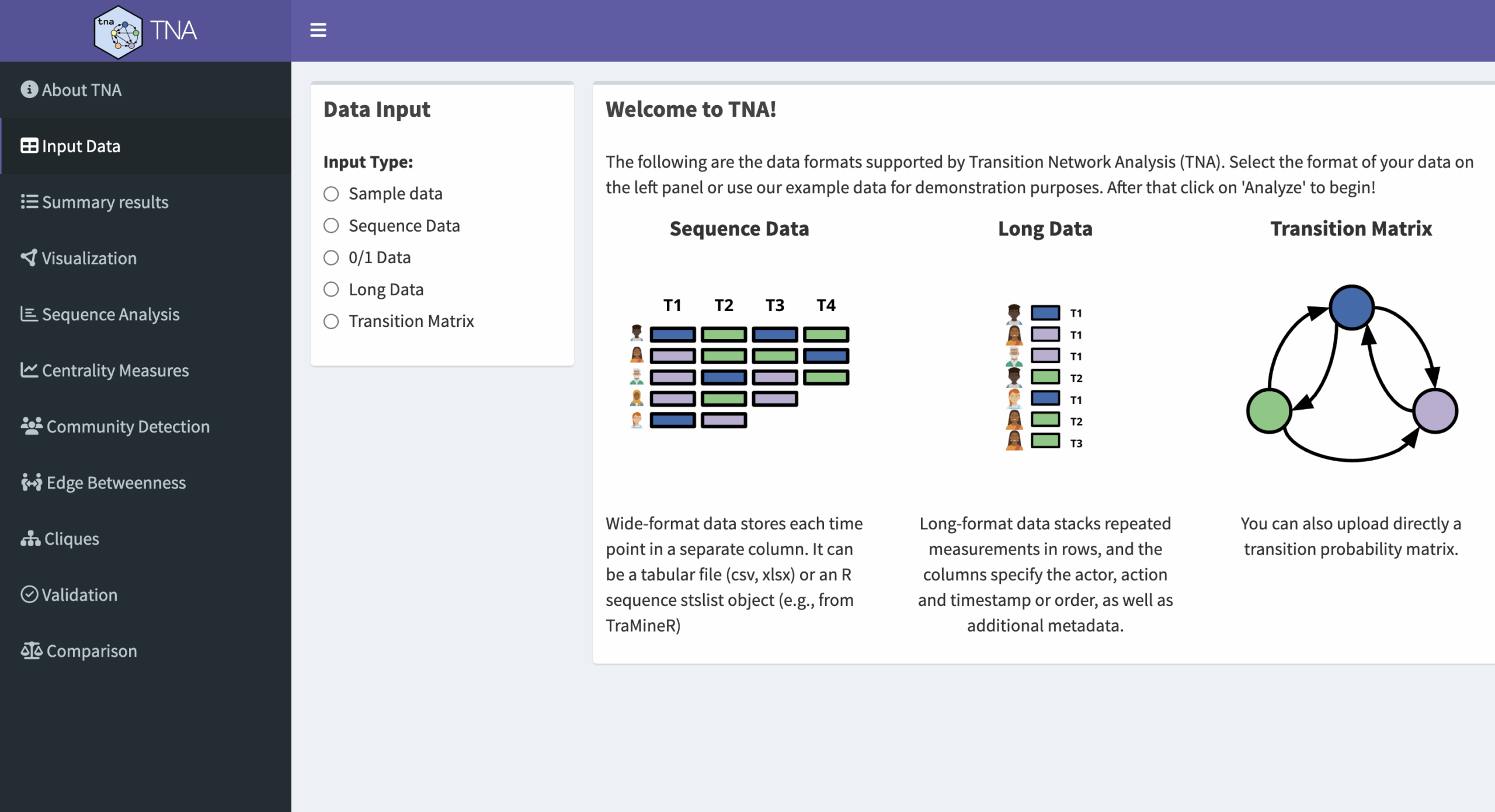
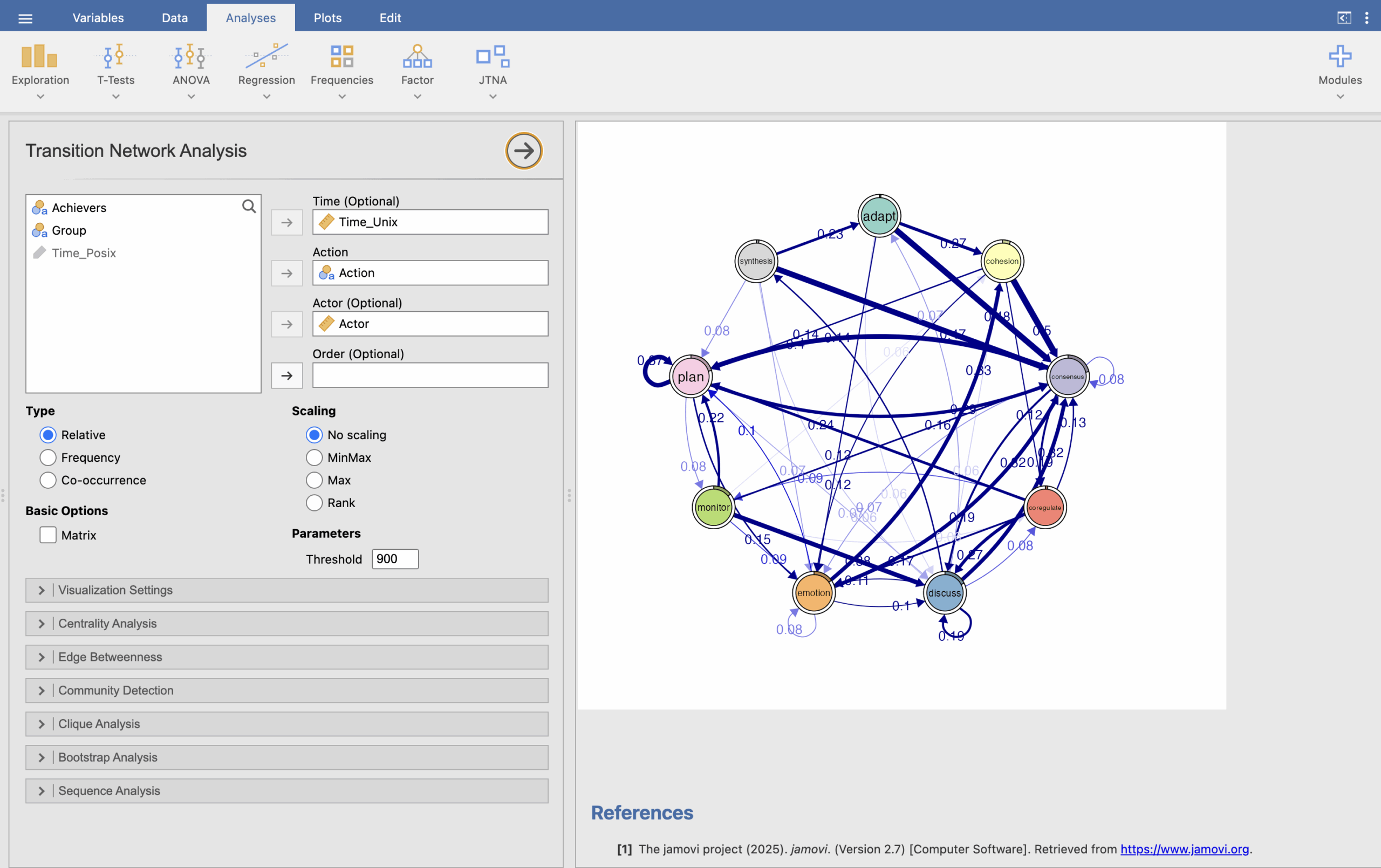
We have also released comprehensive new tutorials for the main TNA features:
Tutorials
- An Updated Comprehensive Tutorial on Transition Network Analysis (TNA)
https://sonsoles.me/posts/tna-tutorial/ - TNA Data Preparation: A Comprehensive Guide to
prepare_data()
https://sonsoles.me/posts/tna-data/ - TNA Group Analysis: Analysis and Comparison of Groups
https://sonsoles.me/posts/tna-group/ - TNA Clustering: Discovering and Analysis of Clusters
https://sonsoles.me/posts/tna-clustering/ - TNA Model Comparison: A Comprehensive Guide to Network Comparison
https://sonsoles.me/posts/tna-compare/ - Full reference guide on
tnafunctions
https://sonsoles.me/tna/tna.html - Sequence Patterns, Outcomes, and Indices with
codyna
https://sonsoles.me/posts/codyna-seq-tutorial/
Vignettes
Check out the tna R package vignettes:
- Getting started with
tna
https://sonsoles.me/tna/articles/tna.html - A showcase of the main
tnafunctions
https://sonsoles.me/tna/articles/complete_tutorial.html - How to prepare data for
tna
https://sonsoles.me/tna/articles/prepare_data.html - Frequency-based TNA
https://sonsoles.me/tna/articles/ftna.html - Attention TNA
https://sonsoles.me/tna/articles/atna.html - Finding cliques and communities
https://sonsoles.me/tna/articles/communities_and_cliques.html - Using grouped sequence data
https://sonsoles.me/tna/articles/grouped_sequences.html
Book chapters
- Basic tutorial: Mohammed Saqr, Sonsoles López-Pernas, Santtu Tikka (2025). Mapping Relational Dynamics with Transition Network Analysis: A Primer and Tutorial. In M. Saqr & S. López-Pernas (Eds.), Advanced Learning Analytics Methods: AI, Precision and Complexity. Springer. https://lamethods.org/book2/chapters/ch15-tna/ch15-tna.html
- Frequency-based TNA: Mohammed Saqr, Sonsoles López-Pernas, Santtu Tikka (2025). Capturing The Breadth and Dynamics of the Temporal Processes with Frequency Transition Network Analysis: A Primer and Tutorial. In M. Saqr & S. López-Pernas (Eds.), Advanced Learning Analytics Methods: AI, Precision and Complexity Springer. https://lamethods.org/book2/chapters/ch16-ftna/ch16-ftna.html
- Clustering: Sonsoles López-Pernas, Santtu Tikka, Mohammed Saqr (2025). Mining Patterns and Clusters with Transition Network Analysis: A Heterogeneity Approach. In M. Saqr & S. López-Pernas (Eds.), Advanced Learning Analytics Methods: AI, Precision and Complexity. Springer. https://lamethods.org/book2/chapters/ch17-tna-clusters/ch17-tna-clusters.html