
Interview with Joanna Maliszewska-Mazek and Anna Samsel, Kulczyk Foundation: Menopause, Social Change, and Systemic Solutions in Poland
02.02.2026
Aija Lulle sat down with the Kulczyk Foundation in Poland to explore how menopause awareness is emerging from discussions of period poverty, and she discovered relevance of midwives – practical, experience‑based approaches to menopause care today.
The Kulczyk Foundation is a private family foundation headquartered in Poland, founded by Grażyna Kulczyk, Jan Kulczyk, PhD and Dominika Kulczyk in 2013. Together with its partners, the foundation fights against inequality affecting women and girls around the world. The goal of Kulczyk Foundation’s activities is to build a reality without any gender restrictions. The Foundation works with social partners in different parts of the globe, initiating change through sustainable solutions. Since its creation, the Kulczyk Foundation has carried out international aid projects in 67 countries across 6 continents
How did Kulczyk foundation begin working on menstrual and menopausal health?
Our work started in 2019, when we were running projects in Kibera, a large informal settlement in Nairobi. There, we learned for the first time that girls often miss school because they cannot afford menstrual products. This shock led us to investigate menstrual health.
In 2020, we published two major reports: a global review of menstrual health and period poverty, and the first comprehensive survey on menstruation in Poland. The findings were clear: period poverty exists in Poland, knowledge is limited, and the topic remains taboo.
From these results, we launched national campaigns, product‑distribution programs, and educational initiatives. Over several years, we moved the topic from complete invisibility to the level of the Ministry of Education, which in 2024 launched the first national pilot addressing period poverty in schools.
How did menopause become part of your work?
For us, menopause is a natural continuation of the menstrual health agenda — from first period to last period. After years of focusing on young people, we realised we could not address only one part of the life cycle.
In 2023, we conducted Poland’s first nationwide report on menopause, Menopause Without Taboo. This research revealed four major problem areas:
- widespread lack of public knowledge
- insufficient training for health professionals
- harmful stereotypes and silence
- lack of support for menopausal women at work
These findings shaped our next steps and made it clear that menopause requires systemic attention similar to menstrual health. In 2024, we decided to delve deeper into the impact of menopause on work and workplaces on women during the perimenopause and commissioned the report “Invisible at Work: Women in Perimenopause.”
How are you addressing the lack of public and specialist knowledge?
We created a website Menopause Without Taboo, where we published a knowledge compendium which includes evidence-based guidance: symptoms, diagnostic steps, questions to ask doctors, and rights patients should know.
We also run and participate in webinars, trainings, and public meetings. Most recently we received municipal funding in Warsaw in order to educate women.
One of the most alarming findings from our research was that menopause education in Poland’s medical curriculum is minimal — often only a few hours. Specialists typically see symptoms of menopause only through the narrow lens of their own discipline. This leads to misdiagnoses, delayed diagnoses, and unnecessary medical costs.
Our goal is to make holistic understanding of menopause standard practice.
I learnt from you about the crucial role of midwives and found it very relevant. Why did you choose to work with midwives, and how did that become a systemic solution?
Surprisingly, our first survey showed that only 3% of women would turn to a midwife for menopause support. Yet experts confirmed that midwives often have the most holistic training for guiding women through menopausal changes.
We developed a national course for midwives, in collaboration with the National Chamber of Nurses and Midwives, the Ministry of Health, and interdisciplinary medical and social experts.
The Ministry expressed their interest in analyzing the possibility of launching the project as a systemic solution. This could be a major structural breakthrough.
What are your plans for systemic change in the coming year?
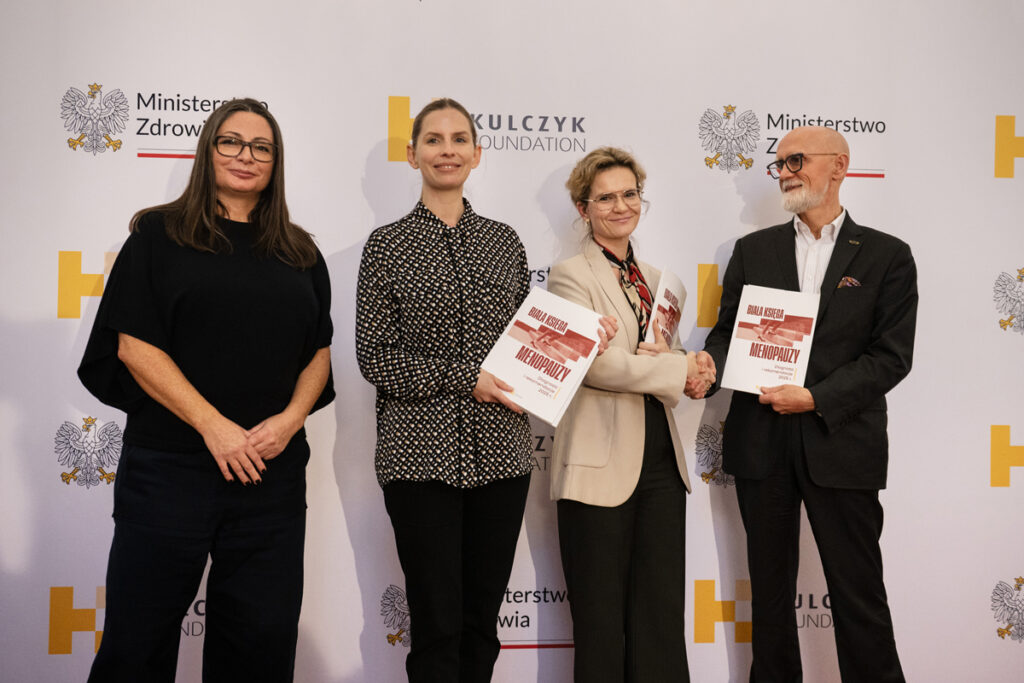
Together with a multidisciplinary team of experts, we worked on a comprehensive report mapping the challenges of menopause in Poland and proposing concrete policy solutions. The result of this work was the report “The White Paper on Menopause. Diagnosis and Recommendations 2025“.
We work with government ministries, policymakers, and various institutions involved in education, health and welfare.
In parallel, we are preparing Poland’s first nationwide social campaign on menopause, aimed at reducing stigma and raising awareness.
Business engagement is also growing. Menopause has entered corporate conversations much more quickly. We treat the workplace as one of the most strategic sites for change. We run Career Cycle – a nationwide programme for employers focus on ensuring widespread access to period products in the workplace and increasing awareness on menstrual and menopousal health. Another projeckt is Równowaga Competition – the competition for Polish organizations where the issue of gender equity is important and cared for in a complex manner. As part of the competition, we educate employers, among other things, about menstrual and menopausal health on an equal footing with other competition areas such as work–life balance, the pay gap, and training and career advancement
How do you see the next 5–10 years of progress?
We believe Poland can achieve all of these goals: free access to menstrual products in public institutions; strong school‑based education on menstrual and menopausal health but also educating medical professionals to take menopause symptoms into account in holistic care; workplaces where menopause is considered part of equity and well‑being policies.
Within a decade, we hope that no student misses school because of menstruation, and no woman feels ashamed or unsupported during menopause.
We aim for menopause and menstruation to be discussed as confidently as work‑life balance or parental leave — not as a taboo, but as a normal part of life. However, in order to achieve the above goals, changing public awareness and providing education in these areas is crucial. That is why all our projects include educational components through which we challenge long-standing taboos.
How do you include men in this work?
Men are essential partners in building a healthy system. We do not want women to carry the burden of adaptation alone.
We recently launched an andropause information initiative, because many households navigate menopause and andropause simultaneously.
In all our educational programs, we invite men to participate. Without men, social attitudes will not change. Understanding reduces shame, and shared knowledge strengthens families, workplaces, and communities.
Resources
- Kulczyk Foundation
- “Menopause Without Taboo” – report, 2023
- Menopause Without Taboo – website
- “Invisible at Work: Women in Perimenopause” – report, 2024
- “The White Paper on Menopause. Diagnosis and Recommendations” – report, 2025
- Career Cycle – programme
- Równowaga Competition (in Polish)
- Interviewer Aija Lulle