
Nordic Nursing Care Chain: Conceptualising a Nordic Model of Nursing Care Mobility within the Global Care Chain Framework
by Katja Laakkonen, 14.9.2026
The 23rd Nordic Migration Research (NMR) conference took place at the Södertörn University, Sweden on 12-14 August 2026.
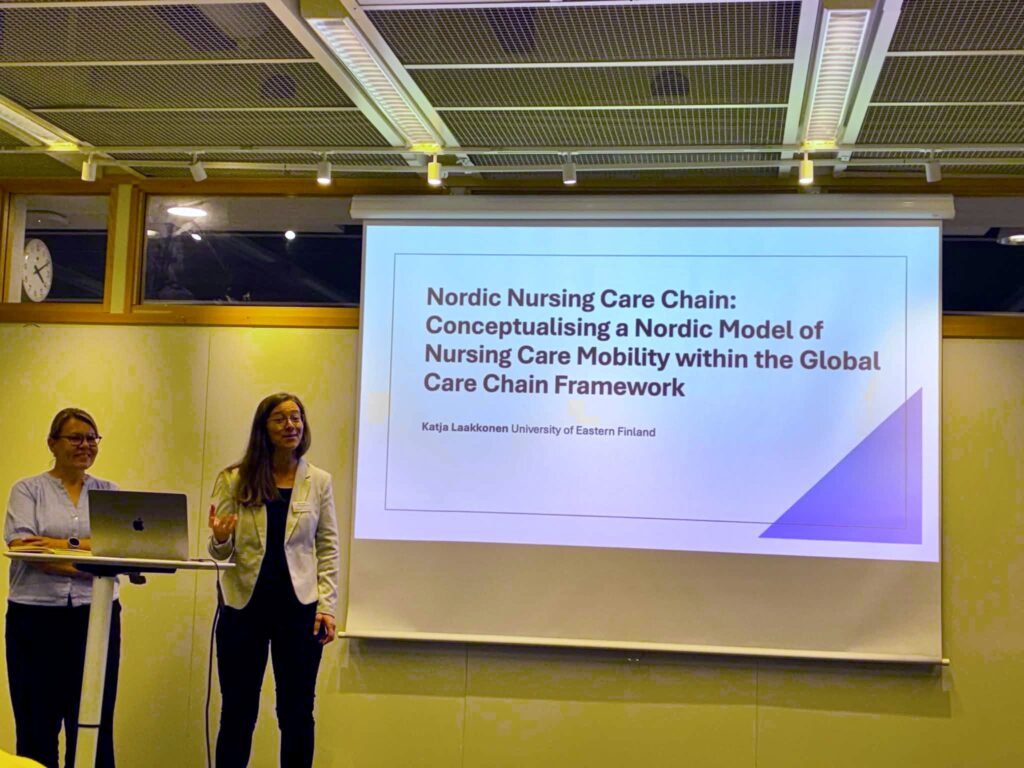
By Katja Laakkonen, Department of Geographical and Historical Studies at the University of Eastern Finland and Mariya Bikova, Department of Health and Functioning, Western Norway University of Applied Sciences
For many Finnish nurses, working in Norway does not mean permanently relocating abroad but rather living a life constantly moving between two countries. Shifts are worked in Norway, while home, family, friendships, and everyday life remain in Finland. It was precisely this transnational everyday life that led me to wonder whether Nordic care labour mobility might require a concept of its own. From this idea, I developed the notion of the Nordic Nursing Care Chain (NNCC) and invited Mariya Bikova, whose research has focused on global care chains, to co-author an article exploring whether the chain metaphor could also be applied to a Nordic context.
Mariya Bikova’s earlier work has examined Global Care Chain (GCC) theory, which analyses the global organisation of care work, particularly movements from the global South to the global North. These frameworks have been essential for understanding the globalisation of care, yet they do not fully capture what happens between Nordic welfare states. This is the gap that the NNCC seeks to address.
In the Nordic region, nursing mobility often involves long-distance commuting between highly similar welfare societies. Cultural proximity, relatively comparable professional standards, free movement, and strong welfare institutions make this type of mobility markedly different from the trajectories typically described in Global Care Chain literature.
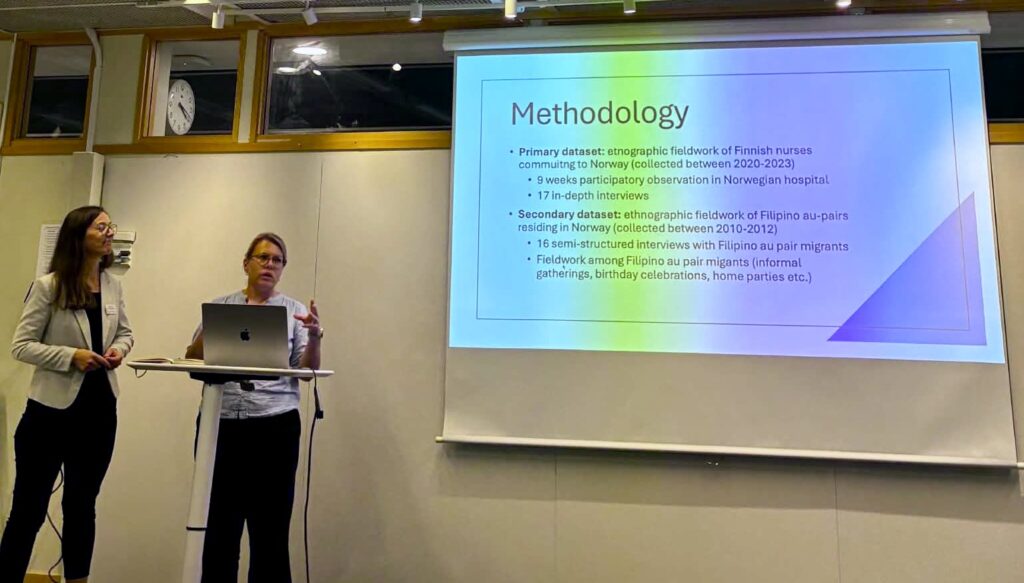
Our empirical material consists of 24 in-depth interviews with Finnish nurses commuting to Norway. The interviews show that these commuters are often middle-aged women. This is one of the key differences compared with many GCC studies, where migrants are frequently younger women and mobility is closely tied to economic necessity. Many of the commuting nurses in the study were empty nesters for whom working abroad represented a long-held dream. The interviews also reveal that Finnish nurses possess considerable bargaining power regarding wages, working schedules, travel arrangements, and accommodation. Mobility does not appear to produce the forms of deskilling that are often discussed in GCC literature. On the contrary, many interviewees described professional agency and improved work-life balance.
The presentation also sparked critical and important questions. Audience members asked why we focused specifically on women and nurses rather than, for example, men or medical doctors. The question was valuable because it highlighted the theoretical foundations of the study. Global Care Chain theory has historically focused on gendered care labour and particularly on women’s mobility. In addition, our material concerns nurses rather than physicians. To our knowledge, Finnish doctors do not commute to Norway on anything like the same scale as Finnish nurses, although the mobility of physicians would certainly make for an interesting topic for future research.
The discussion also highlighted Norway’s particular position within the Nordic labour market. Norway appears to be the most attractive destination country in the Nordic healthcare sector, while Finland functions more as a net exporter of care labour. This makes Nordic mobility interesting not only from the perspective of migration studies but also in terms of welfare state dynamics: welfare states do not merely regulate mobility, they actively produce and shape it.
At the core of the NNCC concept is the idea that mobility takes place upon relatively rigid structures. The chain metaphor has previously been criticised for implying linearity and rigidity. Our argument, however, is that the transnational everyday lives of commuting nurses move constantly “on top of” these structures. This includes physical travel between countries, but also continuous emotional and social connections to home, family, and daily life in Finland.
The rigid elements of the chain include legislation, professional licensing systems, labour market institutions, and trade unions. At the same time, all of this mobility depends upon the infrastructure of Nordic free movement. The NNCC therefore seeks to capture both structure and movement simultaneously: fixed institutional frameworks alongside flexible, rhythmic, and continuous mobility.
As the final presentation of a long conference day, we were ourselves surprised by how dynamic and engaging the session became. The audience’s interest reinforced our sense that Nordic care labour mobility requires new conceptual approaches — ones that recognise mobility between welfare states as a distinct phenomenon within the broader landscape of global care work.