
Catherine Suubi Kayonga: Social support in later life: Highlights from my PhD research findings
What if we could predict longevity based on social support relationships? Our research makes a crucial contribution to making this a reality.
In this post, I will share how our research findings show the benefits/association between social support with longevity and quality of life in old age. We will also explore what this could mean for the future of care for older adults in Finland.
What is social support?
Social support is when a person feels they have someone or people from whom they can receive comfort, love, a sense of belonging, and help in times of need. Social support can take various forms: emotional, instrumental/practical, and informational. Emotional support includes validating feelings, offering comfort and reassurance, and providing a nonjudgmental listening ear. Instrumental/practical support involves assisting with daily tasks and providing financial aid in hard times. Informational support encompasses sharing advice and knowledge that could empower someone to make informed decisions and understand their options in difficult life situations.
Why is social support crucial in old age?
As the world’s population ages, it is essential to emphasise factors that promote good health, independent living, and overall well-being in old age. Previous literature shows that social support has several beneficial effects on the well-being of older adults.
Social support’s link to longevity
For this study, we used data from the Cardiovascular Risk Factors, Ageing and Dementia (CAIDE) project, including 21-year follow-up data from 1,295 participants. Cox proportional hazards models and Kaplan-Meier graphs were used to examine the association between social support dimensions and mortality among older adults.
We found that on average, older adults with social support lived two more years than those without social support. Besides, a higher mortality risk was present for older adults without general and health-related social support from non-relatives. Contrary to expectation, younger older adults below 70 years had a higher risk of mortality without general and health-related social support compared to their over-70 counterparts.
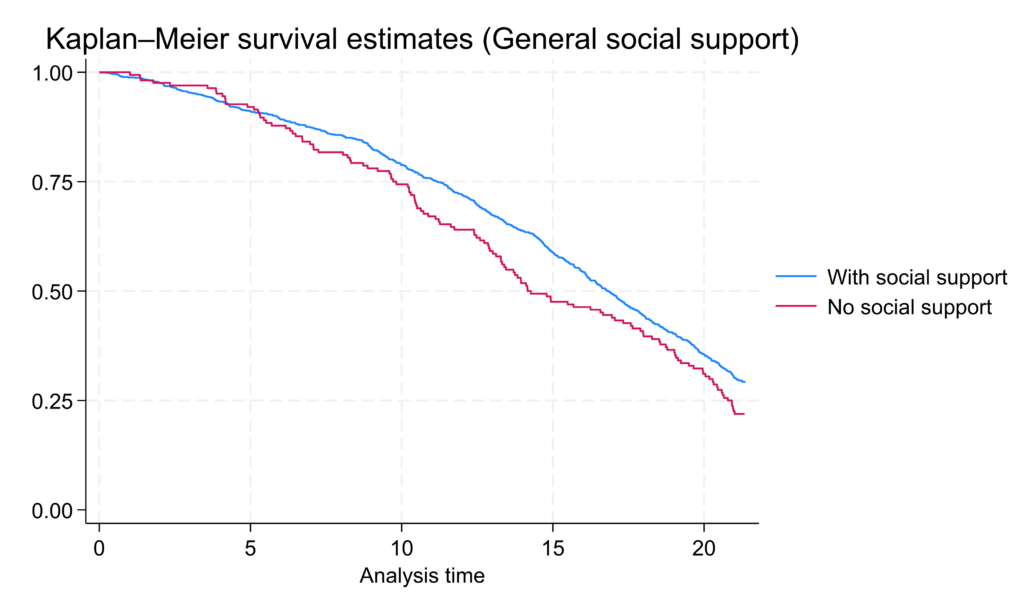
The crucial role of friends, neighbours, and colleagues (non-relatives) in promoting the survival of older adults was shown. Thus, revealing a trend that diverges from previous literature, in which family members played the most significant role in supporting older adults.
Social support improves the quality of life of older home care clients
In this second study, we utilised survey data from Old-age Social Exclusion in Home Care – Prevalence, Meanings & Intervention (SOLDEX) project merged with administrative data. We aimed to examine the association between social support and quality of life among older home care clients and to identify the factors with the most impact on the quality of life.
We found that having social support was associated with a better quality of life, while those with less social support experienced a lower quality of life. Similarly, promoting psychological well-being, such as reducing depression and enhancing functional abilities, including activities of daily living (ADL), improved the quality of life for older adults.
The study emphasised the vital role of higher education in shaping the quality of life in later life. On the other hand, difficulties with activities of daily living were linked to a decline in quality of life among older adults.
Next steps towards the path of impact
Our research highlights the significance and potential of social support in prolonging life and improving the quality of life of older adults. Nonetheless, these findings underscore the importance of recognising and addressing older adults’ social needs alongside their health when developing home care services. By highlighting the crucial role of social support in later life, we could move towards more supportive approaches that promote the sustainable well-being of older adults.
But more strides need to be made before there can be a lasting impact. There is a need to implement policies and activities that enhance older adults’ ability to create and maintain social relationships. Actions to promote physical and social well-being should not only focus on later life but also invest in preventive measures throughout the different stages of an individual’s life (life course).
Research Articles
Kayonga, C. S., Tiilikainen, E., Lisko, I., Hall, A., Solomon, A., Mäki-Petäjä-Leinonen, A., Kulmala, J., Ngandu, T., & Kivipelto, M. (2025). Association Between Social Support Dimensions and Mortality Among Older Adults: 21-Year Follow-Up of the Cardiovascular Risk Factors, Aging and Dementia (CAIDE) Study. Sage Open, 15(2), 21582440251346257. https://doi.org/10.1177/21582440251346257
Kayonga, C. S., Ristolainen, H., Lisko, I., Mäki- Petäjä-Leinonen, A., & Tiilikainen, E. (2025). Association Between Social Support and Quality of Life: Cross-Sectional Study Among Older Adults Receiving Home Care Services in Finland. Home Health Care Management & Practice, 10848223251385092. https://doi.org/10.1177/10848223251385092
Links to projects
https://uefconnect.uef.fi/neuro-innovation/
https://uefconnect.uef.fi/soldex/
https://uefconnect.uef.fi/caide-cardiovascular-risk-factors-aging-and-dementia/
Catherine Kayonga works as a doctoral researcher in the Neuro-Innovation PhD programme. Her research focuses on unmet social and healthcare needs of older people.