
Shekhar Singh: The Neuroscientist’s New Toolkit
How molecular genetics, artificial intelligence and precision technology are reshaping discovery, treatment and the researcher’s role
Neuroscience has long forced researchers to choose a scale: DNA, a cell, a circuit or a patient. That separation is fading. Single-cell and spatial omics reveal which genes are active in particular cell types and where those cells sit in tissue; NIH-supported maps have identified more than 3,000 cell types in the adult human brain. Combined with long-read sequencing, CRISPR perturbation, induced pluripotent stem-cell models, organoids and high-content imaging, these technologies connect a variant to a mechanism with unprecedented resolution (NIH, 2023; Gulati et al., 2025).
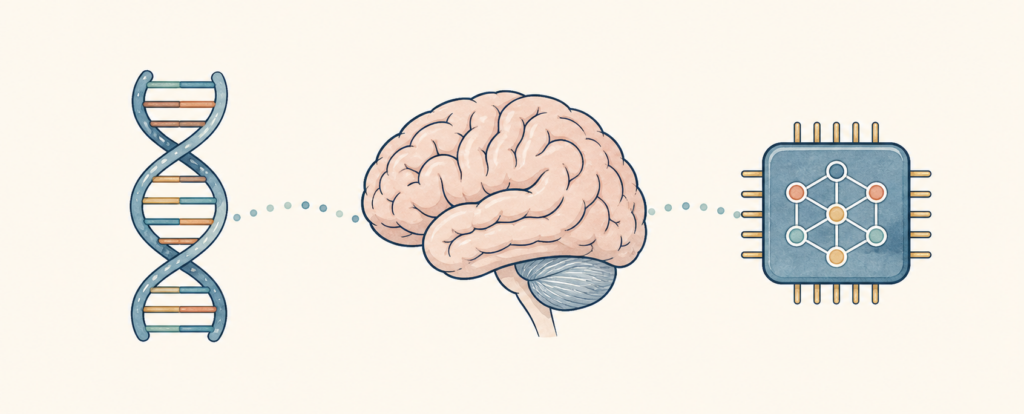
These platforms generate data too large for unaided inspection. AI can prioritize candidate variants, integrate transcriptomic, epigenomic and imaging data, and detect relationships worth testing. AlphaMissense predicts the likely functional effects of missense variants, while AlphaFold 3 models interactions among proteins, nucleic acids and small molecules. Neither is proof. Used well, AI shortens the loop from observation to hypothesis, experiment and revision; used carelessly, it can turn a confident correlation into a false mechanism (Cheng et al., 2023; Abramson et al., 2024).
Molecular discoveries are also becoming treatments. Tofersen (Qalsody) targets SOD1 mRNA in genetically defined ALS, and the AAV therapy eladocagene exuparvovec (Kebilidi) delivers a functional DDC transgene to targeted brain tissue in AADC deficiency. Both received accelerated FDA approval, so confirmatory evidence and long-term follow-up remain important. The broader direction is clear: antisense oligonucleotides, viral vectors, RNA medicines, genome editing and adaptive neuromodulation may increasingly be matched to genotype, cell type, biomarker and network state. AI can help select targets and trial participants, but prospective clinical validation remains non-negotiable (FDA, 2023; FDA, 2024).
The change is good when it increases rigor, speed and access. It is bad when efficiency is confused with understanding. Neurogenetic datasets still underrepresent many ancestries; genomic and neural data are unusually identifiable; and opaque models can amplify batch effects or historical bias. Generative systems may fabricate citations, code or explanations. WHO therefore emphasizes transparency, privacy, independent evaluation and human oversight. In this field, one wrong variant classification can influence diagnosis, reproductive counselling or treatment, so provenance and accountability are scientific necessities, not paperwork (WHO, 2024).
Some tasks are already being automated: first-pass literature triage, routine coding, image segmentation, variant ranking and draft reporting. Replacing an entire researcher is a different proposition. Discovery requires choosing consequential questions, designing controls, handling imperfect samples, noticing artifacts, interpreting negative results, engaging patients and accepting responsibility. The ILO’s 2025 assessment similarly found that generative AI is more likely to transform jobs than eliminate them.
My realistic forecast is that AI copilots will become standard within three to five years, and that many laboratories will automate larger portions of analysis and documentation within five to ten. No credible evidence supports a date for complete replacement of independent biomedical researchers; it may never occur. The vulnerable role is one built mainly from repeatable digital tasks. The durable researcher will combine deep biology with statistics, coding, model evaluation, reproducible workflows and ethics. Our job is shifting from manually performing every step to designing, orchestrating and auditing evidence. AI can accelerate discovery; only accountable human judgment can make it trustworthy (ILO, 2025).
Abramson, J., et al. (2024). Accurate structure prediction of biomolecular interactions with AlphaFold 3. Nature, 630, 493-500. Source
Cheng, J., et al. (2023). Accurate proteome-wide missense variant effect prediction with AlphaMissense. Science, 381, eadg7492. Source
U.S. Food and Drug Administration. (2023). FDA approves treatment of amyotrophic lateral sclerosis associated with a mutation in the SOD1 gene. Source
U.S. Food and Drug Administration. (2024). FDA approves first gene therapy for treatment of aromatic L-amino acid decarboxylase deficiency. Source
Gulati, G. S., et al. (2025). Profiling cell identity and tissue architecture with single-cell and spatial transcriptomics. Nature Reviews Molecular Cell Biology, 26, 11-31. Source
International Labour Organization. (2025). Generative AI and jobs: A refined global index of occupational exposure. Source
National Institutes of Health. (2023). Scientists build largest maps to date of cells in human brain. Source
World Health Organization. (2024). Ethics and governance of artificial intelligence for health: Guidance on large multi-modal models. Source
Shekhar Singh works as a doctoral researcher in the Neuro-Innovation PhD Programme. His research focuses on epilepsy in patients with CSTB mutation.