
Melina Estela Dalmau: Silencing X
We’re all nerds in some subjects. Topics we know in depth, whether through work, studies, or for no particular reason at all (those are the best kind). But what’s crazy is the amount of things we don’t know at all, even facts that others would call basic.
A few months ago I attended a talk on “X-chromosome regulation in human genetics”, a field completely beyond my knowledge, and one basic fact from that talk surprised me. I suspect I’m not the only one who never learned this, so here’s a quick genetics detour.
First, a short recap. Most of us, humans, carry 23 pairs of chromosomes. One chromosome of each pair inherited from each of our two biological parents. Those chromosomes reside in the nucleus of every cell, carrying the genes that keep our cells running, but also being passed on whenever a cell divides.
One particular pair, the 23rd, determines our biological sex. Our biological mother always contributes an X chromosome; our biological father contributes either an X or a Y, and that contribution makes us sexually female (XX) or male (XY).
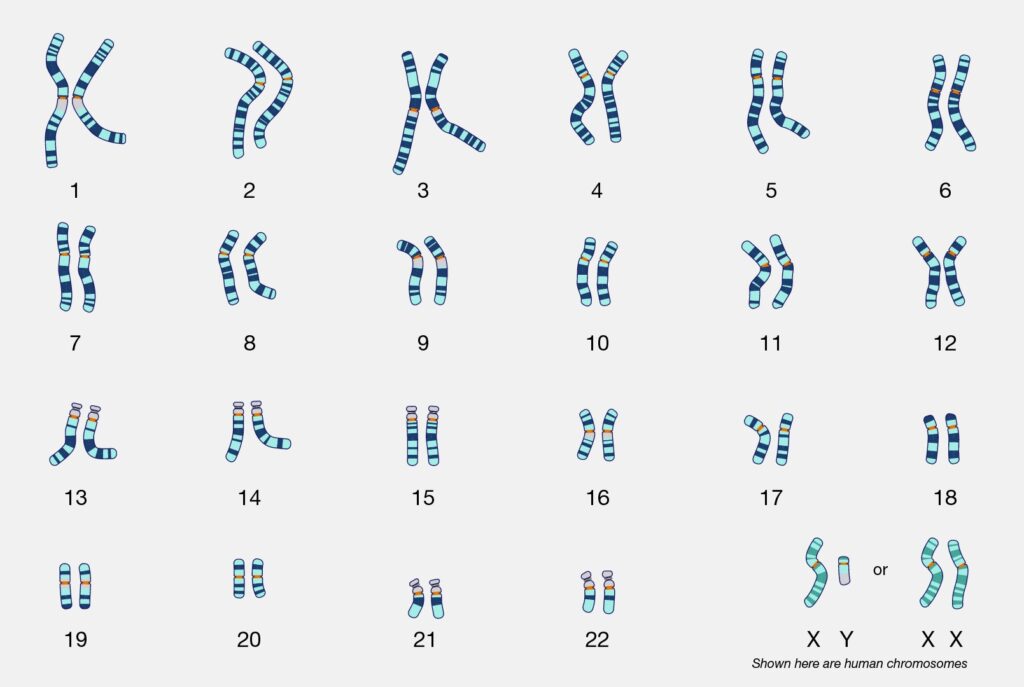
image from https://www.genome.gov/genetics-glossary/Karyotype
Here’s what surprised me. The X chromosome carries about 900 genes, while the Y carries only about 100! If we do the math for the 23rd pair, XX (female) means roughly 1800 genes, while XY (male) is about 1000. That is, in females, the 23rd pair contains almost double the genetic information males have.
But cells run on a fixed dose of genes. So what happens when one sex has more?
X-chromosome inactivation
In females, just a few days after fertilisation, while the embryo is just a small ball of cells, every cell “chooses” one of its two X chromosomes and silences it almost entirely. In practice, only one X stays active per cell, bringing a genetic dose in line with males.
But note: it’s not that one X gets switched off for the whole body. It happens cell by cell, independently. Each cell randomly picks whether to keep the maternal or paternal X active, and as that cell divides over and over throughout development, every one of its descendants inherits the same choice. Because of this cell-by-cell lottery, every person with two X chromosomes ends up as a patchwork of two different cell populations, coexisting throughout the entire body.
A visual example of this is found in cats. The gene for orange vs. black fur sits on the X chromosome. A female cat with one X carrying orange and the other X carrying black ends up with a coat made of orange and black patches, depending on which X got silenced in each patch of skin. So next time you see a cat like this one:

you’re very likely looking at a female (two colors, each color coming from an X chromosome). The white, by the way, comes from a gene on a completely different chromosome, so it shows up in cats of either sex.
None of this is obvious. So who discovered it, and how?
Mary Lyon, England, 1961
A time when “the human body” in medical research usually meant “the male body”.
Mary Lyon was working in mouse genetics, and two observations pointed her toward the answer. First, she found out that female mice carrying two different fur-color genes, one on each X, ended up with patches of both colors instead of a blended color (just as with cats). Second, female mice missing an entire X chromosome were perfectly healthy and fertile, while male mice missing their only X didn’t survive.
Putting the two observations together, she proposed something bold: in every female cell, only one X stays active. The other is silenced early in development, and it’s random which one, maternal or paternal, but once decided, it’s fixed for life in that cell’s descendants. She published it in Nature in 1961.
That was a big claim, so naturally, not everyone bought it. A more senior geneticist, Hans Grüneberg, doubted her and ran his own experiments specifically trying to prove her wrong. And… he couldn’t. A year later, evidence from humans reached the same conclusion, independently. By 1963, the phenomenon had its own name: Lyonization, which is still used today to refer to X-chromosome inactivation in female mammals.
Implications
In males, a mutation on their single X chromosome is enough to cause pathological conditions. As a female, being made of two different cell populations therefore offers some advantages. We are more protected against genetic disorders caused by mutations on the X chromosome, like hemophilia (a disorder where blood doesn’t clot properly) or the red-green color blindness. In females, even if one X carries the mutation, plenty of cells will still have the healthy X active, so the disease often doesn’t show up, or shows up only mildly. Were you aware that 1 in 12 males are red-green color blind? For females, only 1 in 200 are affected!
So it’s not always XY that holds the advantage. Although in terms of raw genetic amounts, biology makes sure we’re not different. The real difference, then, is in whatever specific things we each get curious about. This time for me, it was genetics. What’s been buzzing in your mind?
References
Lyon, M. Gene Action in the X-chromosome of the Mouse (Mus musculus L.). Nature 190, 372–373 (1961). https://doi.org/10.1038/190372a0
Blewitt, M.E. Mary Lyon and the birth of X-inactivation research. Nat Rev Genet 25, 6 (2024). https://doi.org/10.1038/s41576-023-00655-0
Interview to Mary Lyon by Peter Harper, 11.10.2024: https://web.archive.org/web/20150924021514/http://www.genmedhist.info/interviews/Lyon
Introduction to genomics from the National Human Genome Research Institute https://www.genome.gov/About-Genomics/Introduction-to-Genomics
Melina Estela Dalmau works as a doctoral researcher in the Neuro-Innovation PhD programme. Her research seeks to bridge the gap between imaging and brain tissue.