
Discovering the “Secret Ingredient”: How Mathematical Literacy Powers Recipe Scaling
Mathematics Literacy: A Pillar of Culinary Literacy
Integrating mathematics literacy into the kitchen is a fundamental part of culinary literacy; it provides the precision needed so that the application of food and nutrition becomes truly ethereal. The difficult mathematics becomes doable and entertaining; abstract numbers become practical tools used for measuring ingredients, adjusting recipe sizes, figuring out a recipe’s preparation ratios and managing costs. The basics of addition, subtraction, multiplication, division, and ratios are the first steps in culinary mathematics. This post explores recipe scaling to demonstrates a practical use of mathematics in Food and Nutrition, involving the adjustment of ingredient quantities to suit different serving sizes; either larger or smaller than the original.
Core Considerations for Effective Recipe Scaling
(a) To resize a recipe, find the Conversion Factor (CF) by dividing the new yield by the original yield (number of portions in the Standard Recipe). Multiply all ingredients by this factor for the new measurements).
(b) For the best results, measure by weight rather than volume. Experts recommend using a digital scale and grams for accuracy; volume measurements are inconsistent and lead to major errors when scaling recipes.
(c) To deal with fractional eggs, beat a full egg and use only the required portion by weight. For example, if half an egg is needed, whisk it up and measure out approximately 25 to 30 grams.
(d) Pros use baker’s percentages, setting flour at 100% and other ingredients as ratios. This simplifies the process and makes scaling batch sizes effortless).
(e) Scale potent ingredients like spices, salt, fats and oils, thickeners and raising agents cautiously. When doubling, increase them by only 1.5 to 1.75 times or use three-quarters of the calculated amount for large batches; to prevent overpowering flavours or structural collapse.
(f) Large pots evaporate moisture slower than small ones; use 75% of the calculated liquid when scaling soups or stews to maintain the proper thickness.
(g) The goal is to maintain the original food depth when scaling; doubling a recipe in the same pan creates a thicker layer that burns outside before the center cooks. It is therefore ideal to keep the oven temperature the same, or to lower it slightly for deeper dishes or use multiple pans to ensure even cooking. Larger batches take longer to cook, but not proportionally. Checking for doneness at the original time and then every five minutes is also advisable.
Apple pudding is a standard recipe to be scaled up as an example
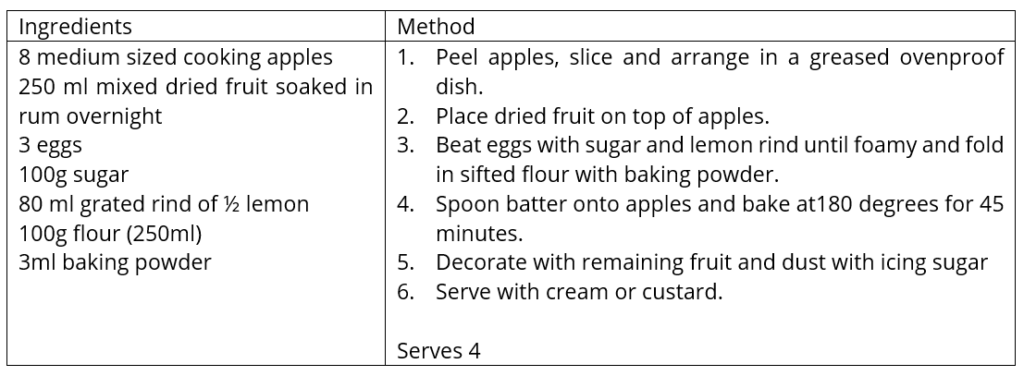
Upscaling the Apple Pudding Recipe
- The apple pudding scaled up to serve 32 people
- CF is calculated by dividing the desired yield by the original yield: 32/4= 8
- CF is used to multiply each ingredient in the Standard Recipe as shown in table 1. Below is a structured table outlining the scaling process and the specific outcomes
Table 1: Apple pudding scaling up of ingredients and the outcomes
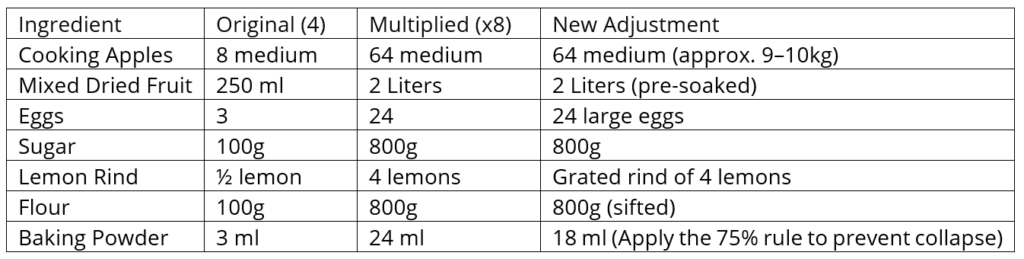
4. All applicable non-linear proportions for recipe scaling must be considered. For example, the 75% Raising Agent Rule for baking powder proportions in the above table. The cooking time, oven temperature, surface area vs. volume and pan size should be mathematically considered as described under core considerations for effective recipe scaling.
Mathematics literacy is the ultimate bridge between wanting to scale a recipe and actually executing it perfectly. Mastering this skill requires a balance of precise calculation and hands-on kitchen experience. When you embrace these quantitative principles, you reveal the ultimate “Secret Ingredient”— How mathematical literacy powers recipe scaling.
Writer
Dr. Manonyane Mamthimkhulu Mafaesa
Inspector-Home Economics
Ministry of Education and Training
Department of Inspectorate
Lesotho