
Projects
This page presents projects on escape game pedagogy carried out at the University of Eastern Finland. These projects have focused on developing pedagogical escape game implementations, learning environments and training content for different target groups and educational contexts.
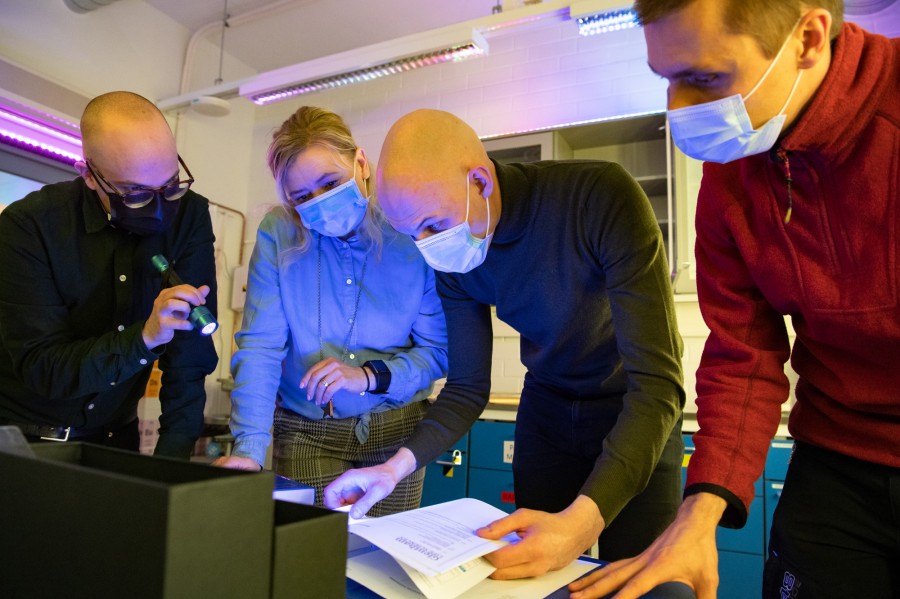
The FarScape escape game test team in action, spring 2021.
FarScape is a pharmaceutical escape game concept developed at the University of Eastern Finland. It provides a functional and game‑based way for pharmacy students to practise professional skills through an escape game. FarScape is located on the Kuopio campus in a learning environment built in the Canthia building. Its work‑life‑oriented tasks assess both theoretical knowledge and practical skills in drug preparation, laboratory work and analytics. The game requires students to solve tasks in teams under time pressure, supporting the development of essential workplace skills such as collaboration, problem‑solving and working under pressure.
FarScape is designed as part of pharmacy education. The game’s tasks guide students to carry out each step carefully and correctly, while also bringing an experiential and motivating element to learning.
The project is carried out by University Lecturers Tarja Toropainen and Krista Laine.
Pakoruotsi is an escape game project carried out in 2021 as a collaboration between the Language Centre and the Department of Applied Education and Teacher Training. The project uses a game‑based approach to practising Swedish. The game is designed for higher education students studying Swedish, with the aim of motivating language learning, applying Swedish language skills and developing teamwork and problem‑solving abilities.
Three different versions of Pakoruotsi have been developed. The game can be played in the Sm4rt LOC escape game laboratory, in a regular classroom, or as a digital version integrated into on‑campus or online teaching. In addition to refresher courses in Swedish, the game can be adapted for discipline‑specific courses.
The project team included Satu Reinikainen and Maarit Turunen from the Language Centre, and Ville Tahvanainen from the Department of Applied Education and Teacher Training.
More information:
- Pakoruotsi project website – including free, non‑commercial game materials for all three versions and tips for creating your own escape game
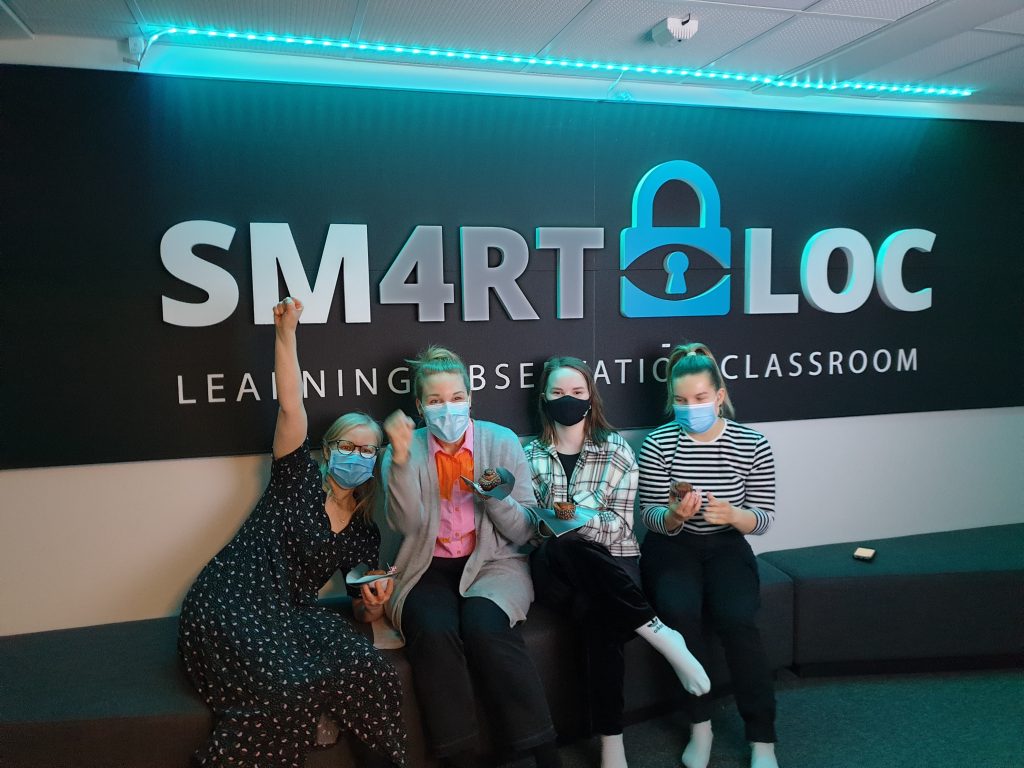
Pilot group for Pakoruotsi, spring 2021.
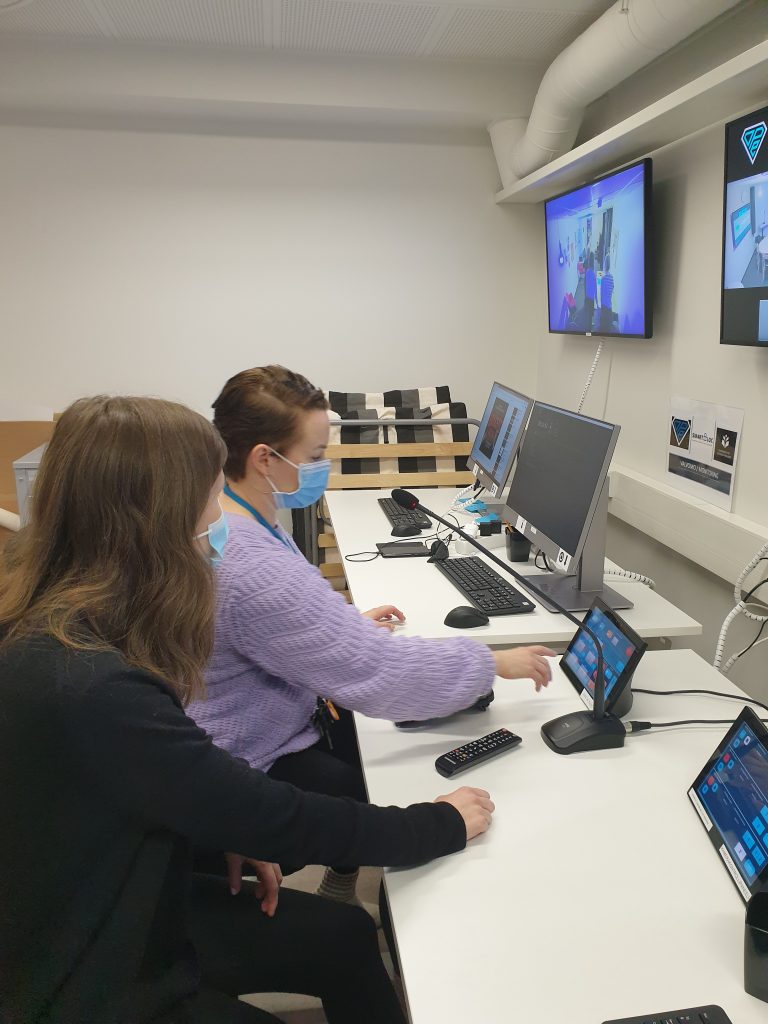
Language Centre teachers Maarit Turunen and Satu Reinikainen guiding the pilot game.
Pakoteekki is a pedagogical escape room developed at the School of Pharmacy at the University of Eastern Finland in collaboration with pharmacy students. The aim of the game is to support students’ professional competence and workplace skills related to pharmacy practice through hands‑on, team‑based tasks.
A virtual reality learning environment, VR Pakoteekki, has also been developed based on the game. VR Pakoteekki helps pharmacy students prepare for their pharmacy practice period. It is a virtual escape game in which students work together to solve tasks related especially to customer counselling and dispensing medications.
The virtual version was developed together with pharmacy student Eemil Sääskilahti, who piloted the game as part of his Master’s thesis. Based on feedback from students who participated in the pilot games, the VR escape game was refined further. The feedback indicates that VR Pakoteekki is well suited for use in pharmacy education.
More information from University Lecturers Piia Siitonen and Tarja Toropainen
EsGaPed was a development project carried out at the University of Eastern Finland in 2023–2024. Its aim was to strengthen expertise in escape game pedagogy and to produce an internationally applicable training package and related materials on escape game pedagogy.
A key emphasis of the project was on building and strengthening expertise and collaboration in escape game pedagogy. The goal was to bring together and pilot a multidisciplinary expert network and to develop a model for its operation so that escape game pedagogy can be applied across different fields of education and diverse teaching contexts.
The project team consisted of Ville Tahvanainen, Sanna Nenonen, Iiris Kangasniemi and Andreas Fischer.
WorryEscape is a project funded by the Ministry of Justice and carried out in collaboration by the University of Eastern Finland and Laurea University of Applied Sciences. The project was implemented in 2024–2025 with the aim of strengthening the financial literacy of young adults through gamification.
Within the project, a financial‑themed escape game was developed. The game addresses everyday financial situations relevant to young people—such as spending, budgeting and making daily financial decisions—and provides opportunities to practise related skills. It is designed especially for professionals who work with young people in guidance and teaching roles, and it is suitable for implementation with young people aged 15 and above.
From UEF, Marilla Kortesalmi and Henna Hakamäki worked on the project.
More information:
Yhdessä pakoon! – Pakopelipedagogiikka yhteisöllisyyden edistäjänä opetuksessa (Escape Together! – Escape Room Pedagogy as a Tool for Enhancing Community in Teaching) was a continuous learning project funded by the Finnish National Agency for Education. The project offered training for teachers in basic education and upper secondary vocational education on how to apply escape game pedagogy in their teaching. Its aim was to support the development of communal teaching practices and to strengthen participatory and creative methods through escape game pedagogy.
The project was implemented in 2024–2026 in collaboration between the University of Eastern Finland, Humak University of Applied Sciences and Kajaani University of Applied Sciences (KAMK). At UEF, the project was carried out by the Centre for Continuous Learning together with the Department of Applied Education and Teacher Training, and the project team included Sanna Soppela, Iiris Kangasniemi and Sini Kontkanen.
The training consisted of four modules. The first two were implemented nationally online, while the remaining two were delivered in regional groups in Kuopio, Joensuu and Kajaani. The content introduced perspectives on game‑based learning and provided guidance for designing both physical and virtual escape games. Participants also received practical tools for designing, implementing and evaluating their own pedagogical escape games.
In the applied modules, participants designed and carried out escape games tailored to their own teaching contexts. Some of the participants’ materials will be published gradually on the Materials page.
The project also produced an open online course, Pedagogiset pakopelit opetuksessa (Pedagogical Escape Games in Teaching), available on the DigiCampus platform (see more on the Escape Game Pedagogy page).