6. Data management plan (DMP)
All information covered so far should be summarized in a data management plan (DMP). It describes the entire life cycle of the research data, including their origin and how they are handled throughout the different phases of the research process.
A DMP is an important part of the research plan, usually included as an attachment, and it should be prepared before the research project begins. The DMP is updated as the study progresses and as new details, specifications, or changes emerge.
A DMP addresses both the administrative and technical management of data as well as the manners and possibilities of opening or sharing the data. The research plan, in turn, discusses research data from the perspective of the research questions and study design, as well as the planned publication of research results.
The DMP helps researchers plan the day-to-day conduct of research and the management of research data throughout the research project.
Research data management and the preparation of a DMP are an integral part of good research practices. These help save time and resources.
A data management plan prepared in advance:
- reduces the risk of research data loss or destruction
- helps ianticipate and manage issues related to ownership and usage rights
- supports compliance with the FAIR principles (Findable, Accessible, Interoperable, and Reusable)
- increases data reusability and enhances the visibility of the research through FAIR-related measures
- helps meet the funders’ requirements
- reflects the principal investigator’s managerial skills as a project leader.
Research funders often require, or at least recommend, a data management plan. Examples include the Research Council of Finland and Horizon Europe. It is therefore important to check the funder’s and organization’s guidelines before preparing a DMP (in the case of UEF, see UEF Open Science and Research Policy).
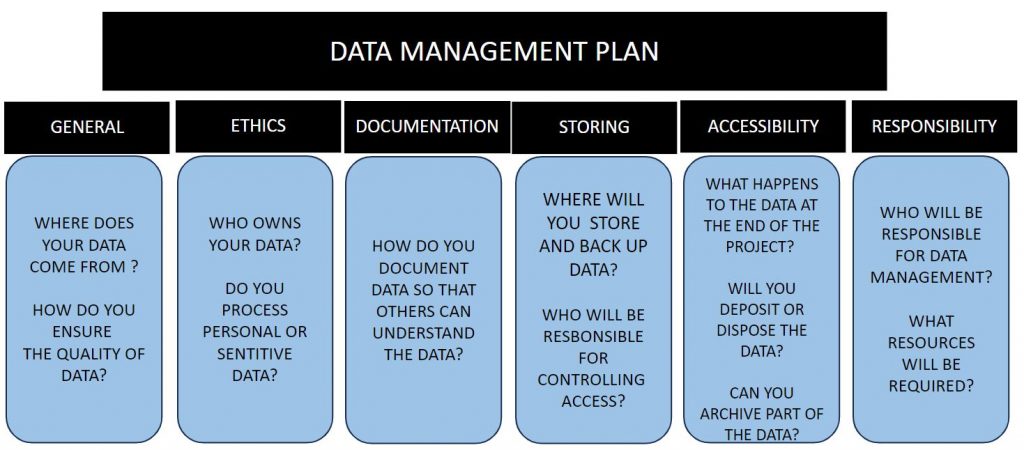
The content and structure of a DMP may vary depending on funder’s requirements and instructions. In Finland, a six-section template (DMP 1 – DMP 6) is commonly used.
In the general description of data in the DMP, you should describe the types of data produced, collected, processed, and reused during the research project, the storage space needed and the formats of the data.
Data can include, for example, text, images, recordings, videos, numerical data, source code, or software. It is important to keep in mind that all research involves data, even if the data are not collected from scratch, for example, through measurement devices or surveys.
Data categories
The general description of data should be concise and may be presented in the form of a list or table. The data can, for example, be categorized as follows:
1. newly collected data (e.g. interviews, measurements)
2. existing data collected or compiled for the research project (e.g. archival materials, media data)
3. existing data used in the research (e.g. survey or measurement data produced in other research projects and reused in this project)
4. data produced during the research (e.g. analyses, code, datasets, lists)
5. administrative data (e.g. contracts, research permits, the data management plan)
6. research documentation and descriptive data (e.g. laboratory notebooks, diaries, notes).
Data format
It is recommended that data be stored in standard formats that are as open as possible and widely used withing the scientific community, so that they can be accessed and read by others in the future.
Size: storage space required
The size of the data is estimated in terms of file size (e.g. KB, MB, GB or TB). This estimate is needed to assess the required storage space. In the DMP, data size therefore refers to the size of the files, not, for example, to the number of interviewees or variables. Such details are described in the research plan.
Data quality: risk assessment
The general description explains how the consistency and quality of the data will be ensured. It should clarify how the data will be kept accurate and intact throughout the data lifecycle, so that the information content does not change when the data are copied, converted from one file format to another, analysed, or otherwise processed.
Practical tips
- Summerise the general description of your research data in a concise table.
- Refer to the numbering system used in the table in other parts of the DMP.
The DMP should clarify the ethical and legal issues related to research data management, including how the data may be collected, processed, shared, and stored, by who, and for what purposes. It should also state the legal requirements and ethical guidelines applicable to the research data are describe the data management procedures that need to be used to comply with them.
Personal data
If personal data is being processed in the research, at least the following issues should be addressed (see also Chapter 2 of this learning material):
- What types of personal data are collected?
- Does the research involve special categories of personal data (i.e. sensitive data)?
- Is an ethical review required?
- How will the privacy of the research participants be ensured?
- Are the data pseudonymised or anonymised?
- How will the anonymisation or the pseudonymisation be carried out?
- What procedures are used to inform research participants about the processing of their personal data?
Non-personal data
Data that do not contain personal data also require consideration of ethical and legal issues as part of the data management plan. Environmental and nature-related data may contain confidential or restricted information, for example because of endangered species, biosecurity concerns, or trade secrets. Ethical and legal issues related to research security and AI should also be taken into account in the data management plan.
Intellectual property rights, agreements
The data management plan must address intellectual property rights (IPR) related to the data, such as copyright, patents, and inventions. For example, research participants may hold copyright to drawings, texts, or other materials they produce.
Any agreements, research permits, and rights of use related to the research data should be described for all data used or produced in the project.
Practical tips
- Check your organisation’s principles and guidelines on copyright, ownership, and rights of use and distribution.
- Check the funder’s policies.
- Ensure that the necessary permissions for storing and sharing the data are in place.
The DMP should describe the principles, methods, and tools used to describe research data and document their handling. The purpose of description and documentation is to ensure that the data remain usable and understandable during the research project and afterwards, if the data can be reused.
Description and documentation also contribute to data quality, which should be discussed in Section 1.2 of the DMP. The content of these two sections may therefore easily overlap.
Metadata play a central role in implementing the FAIR principles. For this reason, metadata and FAIR principles are addressed under the same heading in the DMP template. However, there is no need to explain the FAIR principles themselves. Instead, you should describe how the project’s research data can be made findable, accessible, interoperable, and reusable.
Practical tips
- Before you begin collecting data, plan how you will organize them during the project (e.g., folder structure, naming conventions, version control).
- Describe all the methods, files, tools, and platforms you use to document data handling and to describe the content of the data (e.g. README files, codebooks, laboratory notebooks, diaries, notes, terminology, standardised vocabularies).
- Mention any devices and tools that produce standardised metadata.
- Ensure that general descriptive information is compiled (e.g. the name and author of the dataset).
- Specify any field-specific or data type-specific metadata standards that you may use.
- Describe how you will create a persistent identifier for your data and/or their metadata (e.g. using the Qvain tool or a specific data repository).
The DMP describes how the collection, storage, and backing up of the data are implemented during the research project; data storage after the research is addressed in DMP Section 5.
This section specifies where the data will be stored, how they will be backed up, who will be responsible for controlling access to the data, and how secure access to the data is monitored and controlled during the research project.
If several parties are involved, it is important to plan how the secure transfer of data is ensured within the research group or between collaborators. In other words, this is an essential part of implementing data security and data protection.
Ensuring data security is extremely important, and the storage solution must be adequately protected, particularly if the data are sensitive and contain, for example, special categories of personal data, politically sensitive information, or trade secrets.
Practical tips
- Check and define the correct data classification for your data in accordance with your organisation’s guidelines. This will help you choose an appropriate storage solution.
- Use safe and secure storage services provided and maintained by your organisation’s IT support or another reliable IT provider, such as CSC.
- Do not use external hard drives or memory sticks as your primary storage solution.
- Follow your institution’s requirements for secure data storage.
The DMP describes which parts of the research data can be made openly available, published, or permanently archived. If only the metadata are published, this DMP section should explain why this solution has been chosen.
It is also important to discuss where and when the research data or their metadata will be published, opened, or archived. At the early stages of a project, these solutions may not yet be clear, and it is advisable to state this in the DMP.
The DMP should also specify the retention period for data that will be preserved for a fixed period and indicate when the data, or parts of them, will be destroyed or disposed of.
Practical tips
- If the data contain personal data, check how research participants have been informed about the use of their personal data.
- Pay attention to any risks related to the reuse of the data (including research security and AI).
- Check field-specific, national, or funder recommendations when choosing a suitable place to open, publish, or archive the data.
- Use services (data repositories or archives) that are specifically designed for storing research data and that provide a persistent identifier.
The DMP briefly describes who (e.g. name, position, institution) is responsible for data management during the research project and for the data themselves after the project has concluded. Responsibility for data management may lie with an individual researcher, a research team, or collaborators.
This section should assess the resources needed for data management (e.g. costs, workload, and time), that is, the resources required to implement the measures described in the data management plan.
Guidance on planning data management also emphasises the implementation of open science and the FAIR principles. It is therefore important to describe what resources are needed to store and make the data openly available in accordance with the FAIR principles. However, the individual measures supporting the FAIR principles should not be listed in this section.
You can estimate your data management costs, for example, using the following guidelines and tools:
- Costs of data management (Utrecht University)
- Data management costing tool (TU Delft)
Practical tips
- State who is responsible for preparing and updating the DMP.
- Take into account the need for instructions and training in data management skills within the research group.
- Check how the funder requires data management costs to be defined and itemised.

DMPTuuli is a tool designed to help researchers at Finnish research organisations prepare data management plans. It guides users to consider all relevant questions related to data management. To use DMPTuuli, you need to create an account or sign in with your institutional credentials via HAKA.
DMPTuuli also allows users to work on a DMP collaboratively with project partners, and the completed plan can be attached to a funding application in the required format (e.g., docx, pdf).
DMPTuuli includes DMP examples as well as general, funder-specific, and organisation-specific guidance (e.g. Research Council of Finland, European Commission, and UEF). You can select the guidance you need before you begin writing your data management plan in DMPTuuli.
General Finnish DMP Guidance and additional instructions for planning the management of sensitive and confidential data are also available in DMPTuuli.
In addition to DMPTuuli, several other internationally used DMP tools are also available, such as
- DMPOnline (Digital Curation Center, DCC, Iso-Britannia)
- Research Data Management support (Utrecht University)
- Data Stewardship Wizard
- Argos (OpenAIRE, EUDAT).
- In addition to this learning material, you can find UEF instructions and guidelines on the UEF Data Support and UEF Library websites.
- Familiarise yourself with the General Finnish DMP Guidance.
- If your research has a funder, find out whether it has any requirements or guidelines for data management.
- When writing your DMP, aim to provide a comprehensive description of how you will manage your research data from both technical and administrative perspectives.
- Answer all questions that are relevant to your research data.
- Avoid overlap with the research plan, where you describe the research methods and analysis. In the DMP, you can refer to the research plan, and vice versa.
- A data management plan should not be treated as a simple administrative task for which standardised text is copied from template models without any real intention to implement the planned data management measures. Describe only the measures that are genuinely needed, for example to enable the data to be opened.
- If something is still unresolved or only at the planning stage, it is still worth mentioning it in the DMP. This shows that you are aware of the key data management measures and reminds both you and the entire research group of the issues that remain open.
- Careful planning of data management measures at the beginning of the project and during its development can help prevent later panic and frustration.
(2026-07)
 Previous: 5. After the research
Finish!