Microscope health
Here you can find all information about the latest quality control measurements.
Each report contains the following measurements:
- Laser power
Laser power is measured out of an objective to give the most realistic excitation power on your sample. Especially if you want to measure fluorescent intensities it is important to keep an eye on the actual laser power to be able to draw meaningful conclusions between repetitions. - Point spread function (PSF) information
The PSF characterizes the spatial resolution and imaging performance of the microscope. It determines how fine details can be resolved in an image and plays a central role in image formation models, deconvolution techniques, and quantitative analysis in fluorescence and confocal microscopy. - Co-Registration
Co-registration refers to the microscopes ability to co-localize signals from different wavelengths coming from the same point. In an ideal world the light emitted from the same spot should be registered equally by the microscope independently of the wavelength. However, chromatic aberrations in the objectives or non-ideal alignment of laser lines and/or filter cubes can lead to a chromatic shift in x, y, and z in the real world. Therefore it is important to check the co-registration of a microscope before drawing conclusions of e. g. co-localization results. - Position accuracy and repeatability
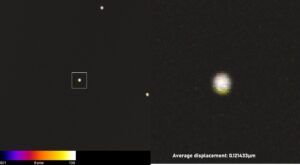
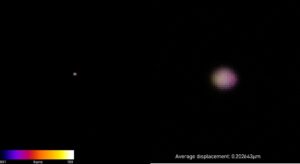
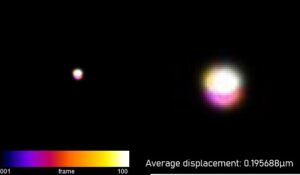
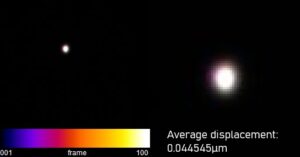
Stage stability is of great importance when performing multidimensional acquisitions involving multiple planes, positions and time points. Stage position repeatability is a measurement of how accurate a motorized stage returns to the same position.
The quality control procedures and the measurements in the reports are based on the following publication:
Faklaris et al., 2022