
Cancer Cell Targeting
Cancer cells often exhibit altered expression of membrane transporters to support their increased demand for nutrients and rapid proliferation. Many members of the Solute Carrier (SLC) family are overexpressed in tumors and can be exploited for selective drug delivery. ATP-binding cassette (ABC) transporters also play important roles in cancer biology and drug resistance by regulating the efflux of therapeutic agents. Together, these transport systems offer unique opportunities for developing more effective and selective cancer therapies.
Our research focuses on two complementary approaches:
1. SLC-mediated delivery of chemotherapeutics
Developing drugs, prodrugs, and drug analogues that utilize transporters, such as L-type Amino Acid Transporter 1 (LAT1), and organic cation transporter 1 and 3 (OCT1/OCT3) to achieve selective accumulation in cancer cells and tumors.
2. Targeting the tumor microenvironment and angiogenesis
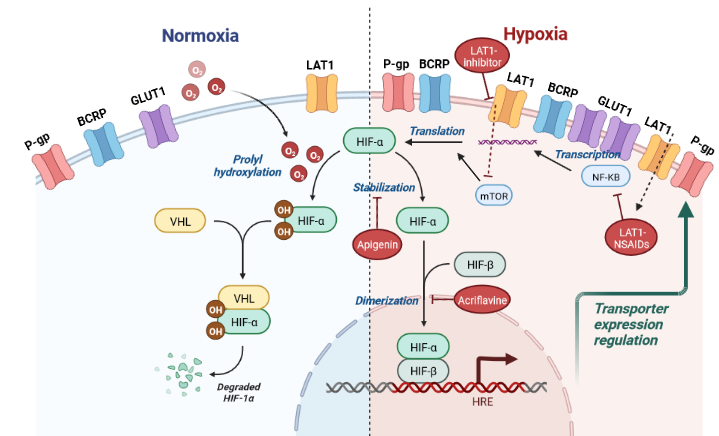
Beyond transporter-mediated drug delivery, we are interested in understanding how the tumor microenvironment and hypoxia regulate transporter expression and function in cancer cells. These mechanisms influence nutrient uptake, drug distribution, and tumor progression, and may reveal new opportunities for transporter-based therapeutic interventions.
Through these approaches, we aim to develop novel transporter-based strategies that improve the selectivity and effectiveness of cancer therapies.
Selected Publications
1. LAT1-Utilizing Prodrugs of Chemotherapeutics or Efflux Transporter Inhibitors
Bahrami, K.; Kärkkäinen, J.; Bibi, S.; Huttunen, J.; Tampio, J.; Montaser, A. B.; Moody, C. L.; Lehtonen, M.; Rautio, J.; Wheelhouse, R.T.; Huttunen, K. M. Selective Transport of Temozolomide Does Not Override DNA Repair-mediated Chemoresistance. European Journal of Pharmaceutical Sciences, 2024, 195:106661. https://doi.org/0.1016/j.ejps.2023.106661
Huttunen, J.; Tampio, J.; Järvinen, J.; Montaser, A.B.; Markowicz-Piasecka, M.; Huttunen, K. M. Amino Acid Derivative of Probenecid Potentiates Apoptosis-Inducing Effects of Vinblastine by Increasing Oxidative Stress in a Cancer Cell-Specific Manner. Chemico-Biological Interactions, 2024, 388: 110833. https://doi.org/10.1016/j.cbi.2023.110833
Markowicz-Piasecka, M.; Huttunen, J.; Montaser, A.; Adla. S. K.; Auriola, S.; Lehtonen, M.; Huttunen K M. Ganciclovir and Its Hemocompatible More Lipophilic Derivative Can Enhance the Apoptotic Effects of Methotrexate by Inhibiting Breast Cancer Resistance Protein (BCRP). International Journal of Molecular Sciences, 2021, 22(14): 7727. https://doi.org/10.3390/ijms22147727
Montaser, A.; Markowicz-Piasecka, M.; Sikora, J.; Jalkanen, J.; Huttunen, K. M. L-Type Amino acid Transporter 1 (LAT1)-Utilizing Efflux Transporter Inhibitors Can Improve the Brain Uptake and Apoptosis-Inducing Effects of Vinblastine in Cancer Cells. International Journal of Pharmaceutics, 2020, 586, 119585. https://doi.org/10.1016/j.ijpharm.2020.119585
Huttunen J.; Gynther, M.; Huttunen, K. M. Targeted Efflux Transporter Inhibitors – A Solution to Improve Poor Cellular Accumulation of Anti-cancer Agents. International Journal of Pharmaceutics, 2018, 550, 278-289. https://doi.org/10.1016/j.ijpharm.2018.08.047
2. OCTs as Novel Anti-Cancer Carriers
Kuorikoski, V.; Tampio, J.; Kerachni, S.; Timonen, D.; Tonduru, A. K.; Markowicz-Piasecka, M.; Terasaki, T.; Poso, A.; Huttunen, K. M. Enhanced Polarity of Sulfonamide Metformin Derivatives Increases Cellular Uptake and Apoptosis-Inducing Effects in Human Breast Cancer Cells. Molecular Pharmaceutics, 2026, 23(2):680-693. http://doi.org/10.1021/acs.molpharmaceut.5c00432
Markowicz-Piasecka, M.; Huttunen, J.; Zajda, A.; Sikora, J.; Huttunen, K. M. Sulfonamide Metformin Derivatives Induce Mitochondrial-Associated Apoptosis and Cell Cycle Arrest in Breast Cancer Cells. Chemico-Biological Interactions, 2022, 352, 109795. https://doi.org/10.1016/j.cbi.2021.109795
Markowicz-Piasecka, M.; Sadowski, K.; Huttunen, J.; Sikora, J.; Huttunen, K.M. Incorporation of Sulfonamide Moiety into Biguanide Scaffold Results in Apoptosis Induction and Cell Cycle Arrest in MCF-7 Breast Cancer Cells. International Journal of Molecular Sciences, 2021, 22(11): 5642. https://doi.org/10.3390/ijms22115642
Markowicz-Piasecka, M.; Komeil, I.; Huttunen, J.; Sikora, J.; Huttunen, K. M. Effective cellular transport of ortho-halogenated sulfonamide derivatives of metformin is related with improved antiproliferative activity and apoptosis induction in MCF-7 cells. International Journal of Molecular Sciences, 2020, 21, 2389-2417. https://doi.org/10.1016/j.bioorg.2019.03.036
Markowicz-Piasecka M, Huttunen J, Sikora J, Huttunen KM. Sulfenamide derivatives can improve transporter-mediated cellular uptake of metformin and induce cytotoxicity in human breast adenocarcinoma cell lines. Bioorganic Chemistry, 2019, 87, 321-334. http://doi.org/10.1016/j.bioorg.2019.03.036
3. Inhibitors of LAT1 as a Novel Anti-Cancer Agents
Huttunen, K. M.; Gynther, M.; Huttunen, J.; Puris, E.; Spicer, J. A.; Denny, W. A. A Selective and Slowly Reversible Inhibitor of L-Type Amino Acid Transporter 1 (LAT1) Potentiates Antiproliferative Drug Efficacy in Cancer Cells. Journal of Medicinal Chemistry, 2016, 59 (12), 5740-5751. http://doi.org/10.1021/acs.jmedchem.6b00190
Markowicz-Piasecka, M.; Huttunen, J.; Montaser, A.; Huttunen, K. M. Hemocompatible LAT1-inhibitor Can Induce Apoptosis in Cancer Cells Without Affecting Brain Amino Acid Homeostasis. Apoptosis, 2020, 25(5), 426-440. http://doi.org/10.1007/s10495-020-01603-7