Bridging Law and Adaptation for Women’s Climate Resilience: Insights from Bangladesh
by Raihanatul Jannat, Doctoral Researcher.
This blogpost is based on the article published in the Carbon and Climate Law Review (CCLR) Journal in December 2025.
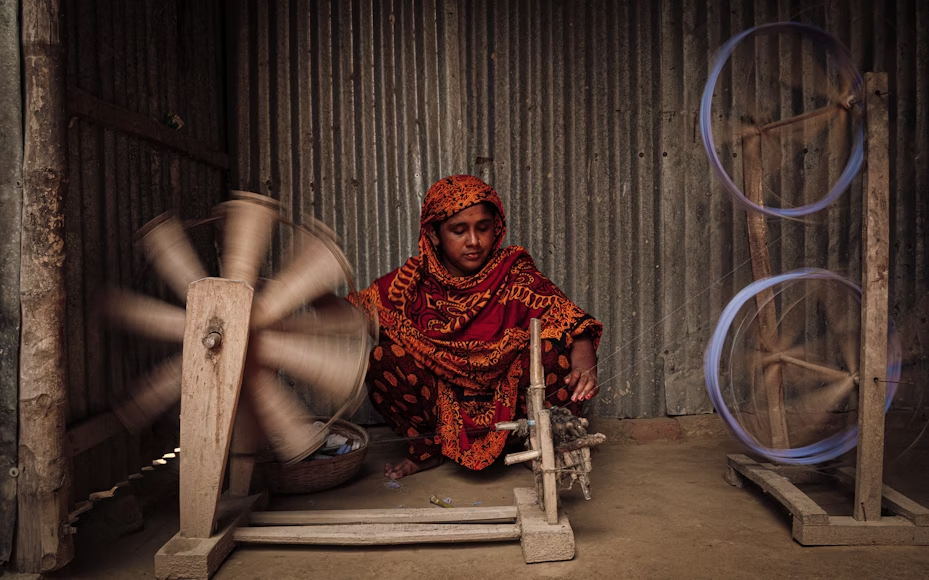
According to the United Nations Framework Convention on Climate Change (UNFCCC), although climate change affects everyone, it exacerbates existing patterns of social injustice, making some groups more vulnerable than others. In Bangladesh, ranked 7th among the most climate-vulnerable countries, climate impacts are deeply gendered. They aggravate women’s food, water, and livelihood insecurities and feed into the traditional patriarchal nature of many communities. These dynamics restrict women’s social and political needs, mute their voices in shaping decisions, and limit their access to and control over resources.
This reality raises a key question: can climate adaptation law and policy support gender-responsive approaches that contribute to climate-resilient development for women in Bangladesh? This blogpost addresses this question by discussing whether climate law with relevance to Bangladesh integrates a gender-responsive approach to adaptation and whether the existing legal framework adequately responds to women’s gender-specific needs and vulnerabilities in the context of climate change. A pluralistic, multilevel perspective is needed, one that considers international, national, and sub-national norms and how they interact in practice.
What is gender-responsive adaptation?
There is no single, universally accepted definition of gender-responsive climate adaptation. Gender-responsiveness can be understood as an intersectional perspective that recognises how individuals’ material realities affect their opportunities and limitations. This involves:
i) a broad understanding of how discriminatory power structures have historically contributed to multidimensional social injustices;
ii) an appreciation of how these injustices currently affect developmental factors such as networks, norms, decision-making processes, economic and educational opportunities, and access to and control over resources; and
iii) an anticipation of how these dynamics may further worsen social discrimination on the basis of gender in the future.
Undertaking a gender-responsive approach creates space for gender mainstreaming, a process through which the implications of gender inequality for any planned action, including legislation, policies, or programmes, are assessed with the goal of achieving gender equality. In climate governance, gender-responsiveness calls into question technocratic approaches to policymaking that present climate responses as neutral or purely technical. It critiques the tendency to treat women as a homogenous group, either as victims due to perceived feminine vulnerabilities or as inherently inclined towards climate-friendly choices based on stereotypical notions of femininity. Instead, it recognises that women, like men, may act as agents of resource depletion in times of scarcity, while also acknowledging that women’s lesser political and social standing within discriminatory structures can provide them with context-specific knowledge that is valuable for inclusive climate action.
As an end goal, gender-responsive adaptation measures contribute to transformations of social systems that can challenge and dismantle discriminatory power structures and support a climate-resilient future.
In practice, gender-responsive adaptation may manifest through a range of initiatives and opportunities. These include the initiation of social and political practices that move beyond acknowledging women as a single gender group and instead recognise broader identities rooted in geography, race, ethnicity, community, religion, sexuality, and economic divides. They may be reflected in policy reforms that challenge patriarchal cultural norms which often operate as barriers to women and girls’ representation in decision-making processes. They may involve developing new decision-making processes that renegotiate the status quo and address the common practice of limiting women’s political power. Gender-responsive adaptation can also take shape through reform of social and cultural systems that not only emphasise the inclusion of women but ensure both their right to participate and their right to be heard. Furthermore, gender-responsive adaptation may involve establishing policy-making systems that provide women and girls with better access to health and reproductive rights and protection, and legal reforms that address economic and productive assets, property rights, and access to information on climate-resilient practices in agricultural, industrial, and other economic activities.
However, the presence of gender-responsive initiatives does not automatically render adaptation effective. The effectiveness of adaptation depends largely on the adaptive capacity of the society in context, understood as the extent to which a societal system can expand and transform itself to absorb and cope with climate-related adversities. Where gender-responsive adaptation is not effective, it can lead to maladaptation and entrench existing gender inequalities, thereby further limiting women’s adaptive capacity and disrupting their climate-resilient development.
The normative landscape for gender-responsive climate adaptation in Bangladesh
The normative landscape for gender-responsive climate adaptation with regards to Bangladesh can be understood across three levels: international, national, and sub-national, reflecting its heterogeneous nature and the different sources of normative potential that exist in parallel to advance the common goal of gender-responsive adaptation.
International level
At the international level, relevant norms include the UN Framework Convention on Climate Change (UNFCCC) and its Paris Agreement, the Enhanced Lima Work Programme on Gender and its Gender Action Plan (GAP), the UN 2030 Agenda for Sustainable Development and associated Sustainable Development Goals (SDGs), and the Convention on the Elimination of All Forms of Discrimination against Women (CEDAW). These instruments exemplify current global progress on gender-responsive adaptation and range from legally binding treaties to political goals under international law.
The original text of the UNFCCC, adopted in 1992, did not contain any specific mandate on gender equality, women, or vulnerable social groups. It did, however, include commitments to meet the needs and considerations of country groups particularly vulnerable to climate impacts. Only in 2001 did decisions under the UNFCCC first call for improved participation of women in climate negotiations and stipulate that national adaptation processes should be guided by gender equality. It took more than a decade after that to include a gender balance goal on the Conference of the Parties (COP) agenda, and even the IPCC assessment reports did not explicitly connect gender considerations with climate action until 2014.
The adoption of the Paris Agreement at COP 21 marked a significant shift. The Agreement, to which Bangladesh is a party, recognises gender equality as a preliminary requirement for all climate action. Its preamble encourages Parties to respect and promote human rights, including gender equality and the empowerment of women, when taking climate action. Article 3 incorporates a hybrid decentralised approach via nationally determined contributions (NDCs), enabling Parties to flexibly combine measures based on national needs and Paris Agreement requirements. NDCs thus embody Parties’ efforts not only to mitigate emissions but also to adapt to climate impacts.
Article 7 of the Paris Agreement establishes the global goal on adaptation and urges countries to undertake adaptation actions that are participatory, transparent, and gender-responsive. Parties are encouraged to integrate adaptation into relevant socioeconomic and environmental policies and to prepare and submit adaptation communications, including National Adaptation Plans (NAPs), which enable them to assess vulnerabilities, mainstream climate risks, and address adaptation needs. While NAPs are not binding, they play a crucial role as instruments that can transform social, political, and governance systems and ensure that adaptation becomes an integral part of national politics, development planning, decision-making, and budgeting.
The Enhanced Lima Work Programme on Gender and its annexed GAP are particularly significant for advancing gender-responsive climate action within the UNFCCC regime. The GAP sets out priority areas, including capacity-building and knowledge sharing, improving gender balance and women’s participation in UNFCCC processes, strengthening gender considerations in climate action, contributing to gender equality and women’s empowerment through climate measures, and enhancing monitoring and reporting of gender-related mandates. Although the GAP is institutionally confined to the UNFCCC process and does not monitor progress on the ground, it represents a concerted effort to mainstream gender across all elements of climate action and to engage a range of actors, from constituted bodies and national focal points to local and community actors. Recent decisions have extended the Enhanced Lima Work Programme for a further ten years and initiated the development of a new GAP, indicating continued recognition of the importance of gender in climate governance.
The SDGs establish linkages between economic, social, and environmental objectives and reinforce opportunities for building climate resilience. While they are generally considered soft law, achieving the SDGs depends on governance processes capable of bringing together cross-cutting tools, multiple actors, and sectors. Given the synergies between climate action and sustainable development, furthering SDGs is conducive to limiting the gendered impacts of climate change and its effects on existing power dynamics. SDG 5, on gender equality, promotes mechanisms that can enhance women’s social and economic capacities and can thereby support efforts to address the gendered implications of climate change.
CEDAW, as an international treaty addressing discrimination against women, imposes legally binding obligations on its state parties, including Bangladesh, to uphold gender equality. Although it does not explicitly focus on climate change, its general recommendations and statements on gender equality provide additional guidance for addressing the gendered dimensions of climate impacts and adaptation.
National level
At the national level, climate-relevant instruments include the Bangladesh Climate Change Strategy and Action Plan (BCCSAP), the Climate Change and Gender Action Plan (CCGAP), Bangladesh’s NDCs, the National Adaptation Plan (NAP) 2023–2050, and the Mujib Climate Prosperity Plan. These instruments, while broadly categorised as soft law, are particularly relevant given the absence of a formal hard law addressing climate adaptation in Bangladesh. They have the capacity to influence climate adaptation and shape how gender-responsive approaches are integrated into policy and practice.
These national instruments increasingly acknowledge that climate change has gender-differentiated impacts and that women’s vulnerabilities must be addressed. They often recognise women as a group disproportionately affected by climate impacts and, in some cases, include specific references to women’s participation, capacity-building, or targeted programmes. The CCGAP, in particular, is designed to integrate gender considerations into climate action more systematically.
Nonetheless, gender-responsiveness remains uneven and often limited. Gender-related language in policies does not always translate into concrete obligations, measurable targets, or robust implementation mechanisms. In some instances, gender is treated as a cross-cutting issue in principle, but without detailed operational guidance or dedicated resources to ensure that adaptation measures genuinely identify women’s needs, guarantee their equitable participation, and secure a fair distribution of benefits.
Sub-national level
At the sub-national level, the Local Adaptation Plan of Action (LAPA), developed by the Bangladesh Academy for Rural Development with support from international partners, plays a key role. LAPA is a policy guideline implemented by local government and intended to facilitate vertical integration of the NAP at local level. Although non-binding, it is sui generis in that it can influence locally-led gender-responsive adaptation and showcases collaborative processes between normative entities engaged in climate adaptation in Bangladesh.
LAPA’s relevance lies in its potential to translate national adaptation priorities into context-specific local action, including measures that can address women’s differentiated needs, support their participation, and influence how benefits are distributed at the community level. As with the national instruments, however, its effectiveness for gender-responsive adaptation depends on how far its guidance is taken up in practice and supported with appropriate resources, capacities, and institutional commitment.
In conclusion, across international, national, and sub-national levels, the existing normative landscape goes some way towards recognising the gender-differentiated impacts of climate change and the need for gender-responsive adaptation in Bangladesh. There are explicit references to women’s vulnerabilities, participation, and empowerment in global climate instruments, national policies, and local guidelines. However, these commitments are unevenly integrated and often lack the concrete obligations, enforcement mechanisms, and resourcing needed to ensure that the gender-specific needs of Bangladeshi women are adequately met in practice.
The current legal framework thus only partially realises the potential of gender-responsive adaptation to support women’s climate-resilient development. Closing the gap between intent and implementation requires stronger collaboration between normative entities at international, national, and sub-national levels, as well as legal and policy reforms that embed gender-responsiveness more firmly in adaptation planning, decision-making, and resource allocation. By strengthening legal frameworks and their implementation in this way, gender-responsive adaptation can more effectively challenge discriminatory power structures and contribute to a climate-resilient future for Bangladeshi women.